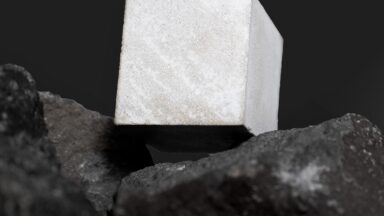
Running the numbers on a zero-emission way to make cement
Cement production is a significant contributor to global CO2 emissions, accounting for approximately 8 percent of the total. As the industry grapples with this environmental challenge, researchers are exploring innovative solutions to reduce these emissions. While enhancing efficiency and transitioning to cleaner energy sources are part of the strategy, a persistent issue remains: the CO2 released when limestone is converted into lime during the production process. A recent study published in Communications Sustainability proposes a groundbreaking approach to eliminate these direct process emissions by challenging the long-held assumption that limestone is essential for cement production. Traditionally, Portland cement, developed in the 1800s, is created by heating limestone (calcium carbonate) and mixing it with materials like clay or coal ash. This process not only yields the desired calcium oxide (lime) but also emits CO2 due to the chemical reaction involved. The authors of this study, including a CEO and an engineer from a company that has successfully produced Portland cement using silicate rocks such as basalt at a laboratory scale, present a compelling alternative. Basalt is rich in a diverse range of minerals, including calcium, aluminum, iron, magnesium, sodium, silicon, and oxygen, but notably lacks carbon. The innovative process involves extracting calcium from basalt through methods resembling refining or recycling rather than the straightforward heating of limestone. By employing acid to leach calcium and then using a chemical or energetic process to precipitate it as calcium hydroxide, the resulting mixture can be processed in a kiln with fewer heating requirements. This method promises to produce Portland cement with only water vapor emitted as a byproduct, marking a significant step towards sustainable cement production.
Uber and Nuro Kick Off Driverless Trials for Lucid Robotaxis Ahead of 2027 Launch
Uber and Nuro have officially launched their driverless testing phase for the Lucid Gravity SUVs on the streets of the S...
TechCrunch | Nov 24, 2026, 17:15
UK Government Sounds Alarm on Surge of AI-Enhanced Cyber Threats
The United Kingdom's cybersecurity agency has reported a significant increase in cyberattacks driven by artificial intel...
TechCrunch | Nov 24, 2026, 18:30
Revolutionizing Cybersecurity: AI's Role in Modern Threat Detection and Defense
As businesses increasingly embrace digital transformation and artificial intelligence, the complexity of cybersecurity t...
Business Today | Nov 24, 2026, 08:30
Electric Truck Innovator Harbinger Secures Major Funding from Erebor Bank
Harbinger, an emerging player in the electric truck industry, has secured a significant financial boost from Erebor Bank...
TechCrunch | Nov 24, 2026, 18:00
Mathematicians React to Controversial Joke Over Lengthy Proof of Riemann Hypothesis
Tensions are rising in the mathematical community following a controversial comment made by Levent Alpöge, a researcher ...
Business Insider | Nov 24, 2026, 17:30