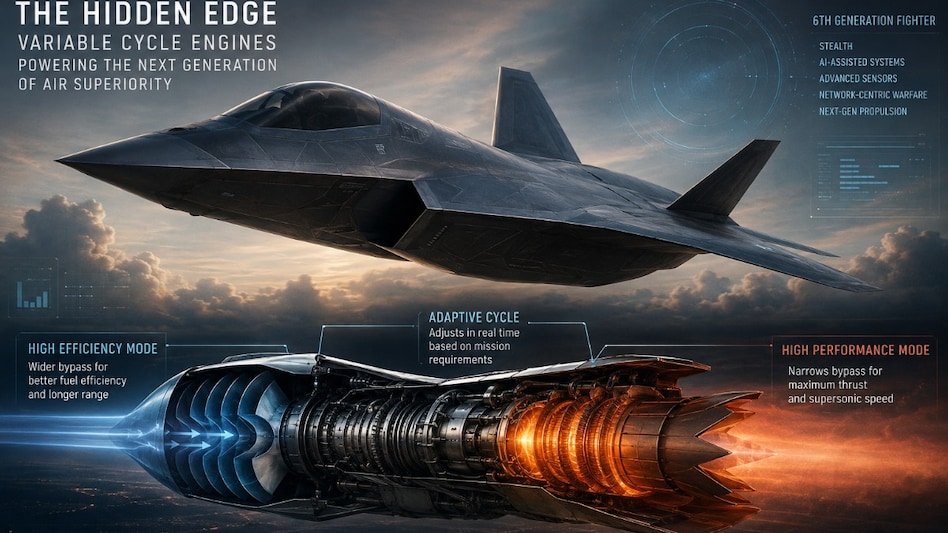
Future of 6th gen fighter jets starts with the engine: Why Variable Cycle tech is the next big leap
The race for dominance in the skies is entering a transformative era. While advancements in stealth technology, artificial intelligence, and sophisticated sensors are frequently highlighted in discussions about sixth-generation fighter jets, experts suggest that the true game-changer lies in the engine design. At the forefront of this evolution is the Variable Cycle Engine (VCE), a groundbreaking propulsion system aimed at resolving one of the longstanding dilemmas in military aviation: the trade-off between speed and fuel efficiency. Unlike traditional fighter engines, which are tailored for a narrow range of performance, Variable Cycle Engines possess the unique ability to adapt to various flight conditions. This innovation results in a propulsion system capable of producing significant thrust during combat scenarios, while simultaneously enhancing fuel efficiency during extended missions. This adaptability positions VCE as a cornerstone technology for the next generation of aerial combatants. Current fifth-generation fighters utilize low-bypass turbofan engines that deliver immense thrust, facilitating quick acceleration and impressive maneuverability. However, these engines come with a notable drawback: high fuel consumption, particularly during prolonged high-speed operations. To extend their operational range, these aircraft often require additional fuel, which can lead to weight increases or compromise stealth capabilities. Designers have long grappled with the challenge of balancing combat readiness with endurance. In contrast, commercial aircraft achieve fuel efficiency through high-bypass turbofan engines, but these designs are unsuitable for the demands of high-speed combat. This gap in capability has driven military engineers to seek solutions that can effectively operate across a diverse range of flight profiles. The mechanics of a Variable Cycle Engine allow for dynamic airflow adjustment during flight. While cruising or on long-range missions, the engine channels more air around its core, acting like a high-bypass turbofan for optimal fuel efficiency. When maximum performance is required—such as during combat or rapid acceleration—the engine shifts to a low-bypass mode, significantly enhancing thrust. This capability to switch operational modes continuously ensures that pilots can achieve both efficiency and high performance, eliminating the need to choose between speed and range. Looking ahead, future combat aircraft are expected to house far more advanced systems than current models, including sophisticated radar, electronic warfare tools, AI-driven mission systems, secure communications, and potentially directed-energy weapons. These enhancements will necessitate increased electrical power and improved thermal management, which Variable Cycle Engines are designed to provide. They promise to extend operational range, enabling aircraft to remain engaged in contested airspace longer while maintaining combat effectiveness. One of the standout benefits of adaptive propulsion technology is its potential to enhance supercruise capabilities—sustaining supersonic speeds without heavy reliance on afterburners, which are notorious for high fuel consumption and increased detectability. By optimizing airflow under different conditions, VCEs can deliver superior performance while minimizing fuel usage and thermal signatures. However, the development of Variable Cycle Engines presents significant engineering hurdles. The technology demands intricate airflow control systems, adjustable internal components, and advanced materials that can withstand extreme temperatures and mechanical stress. Engineers face the challenge of ensuring that the engine can transition between its different operating modes seamlessly, without sacrificing reliability or performance. Although there is still no universally accepted definition for sixth-generation fighters, adaptive propulsion has emerged as a critical component, alongside innovations in stealth, autonomy, and next-generation sensors. The journey toward these advanced aircraft is fraught with challenges, but the potential rewards could redefine aerial combat as we know it.
realme P4x 5G vs vivo Y31t 5G: Which Smartphone Offers the Best Bang for Your Buck?
When it comes to choosing between the realme P4x 5G and the vivo Y31t 5G, potential buyers are faced with distinct advan...
Business Today | Nov 24, 2026, 01:50
Saudi Engineer Faces Legal Battle Over Alleged Espionage Using AI Tech
A Saudi engineer employed by OpenAI, Abdulrahman Alfozan, is at the center of a legal dispute as prosecutors allege he u...
Business Insider | Nov 23, 2026, 23:50UK Government Sounds Alarm on Surge of AI-Enhanced Cyber Threats
The United Kingdom's cybersecurity agency has reported a significant increase in cyberattacks driven by artificial intel...
TechCrunch | Nov 24, 2026, 18:30
Electric Truck Innovator Harbinger Secures Major Funding from Erebor Bank
Harbinger, an emerging player in the electric truck industry, has secured a significant financial boost from Erebor Bank...
TechCrunch | Nov 24, 2026, 18:00
Staggering Recovery Rates Highlight Digital Payment Fraud Challenges
The battle against digital payment fraud continues to be an uphill struggle for consumers, with official data revealing ...
Business Today | Nov 24, 2026, 09:30