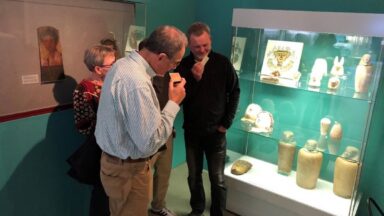
Museums incorporate “scent of the afterlife” into Egyptian exhibits
In a groundbreaking initiative, researchers have unveiled the complex recipes of balms used to mummify the organs of a noblewoman from ancient Egypt. These findings, published in 2023, indicate that the embalming mixtures incorporated ingredients that were not native to the region, showcasing the sophistication of ancient Egyptian practices. In a creative collaboration, co-author Barbara Huber from the Max Planck Institute of Geoanthropology and the University of Tübingen worked alongside a perfumer to recreate what she refers to as "the scent of eternity." This unique fragrance has now been integrated into exhibitions at two museums, enriching the visitor experience and providing a sensory dimension to the understanding of embalming. Historically, the practice of embalming in Egypt dates back to the Predynastic Period or possibly even earlier. Early Egyptians observed that the dry desert climate naturally preserved bodies buried in sand. As burial practices evolved, so too did the methods of preservation, which became intertwined with their religious beliefs. As tombs transitioned from sandy graves to rock chambers, the use of substances like natron salt and plant resins became common. The embalming process typically involved laying the body on a table, where internal organs were removed—with the exception of the heart. According to the ancient historian Herodotus, the brain was extracted through the nostrils using an iron hook, while other drugs were injected to liquefy the remaining matter. Following this, the cavity was cleansed with aromatic spices and palm wine, after which the body was sewn up. To further preserve the body, aromatic plants and spices were placed inside, alongside bags of natron. The dehydration process took about 40 days, during which the organs were either sealed in canopic jars or returned to the body. Finally, the body was meticulously wrapped in layers of linen, interspersed with protective amulets to guard against evil. To secure the mummified remains, a protective resin coating was applied before placing the mummy in a sealed coffin, also treated with resin, ensuring its protection for eternity.
Nationwide Protests Erupt Against AI Data Centers as Communities Demand a Voice
A wave of grassroots activism swept across the United States on Saturday, as citizens rallied against the expansion of A...
Business Insider | Jul 18, 2026, 20:45EU Pushes for Fair Play in AI Assistants, Sparking Tensions with Google and Apple
In a bold move, the European Commission is challenging tech giants Google and Apple over their dominance in the AI assis...
CNN | Jul 19, 2026, 10:40
How an AI Assistant Transforms a Busy Mom's Life: A Personal Journey
In the fast-paced life of a busy mother, managing responsibilities can often feel overwhelming. Erin Kee, a 38-year-old ...
Business Insider | Jul 19, 2026, 09:00Yang Zhilin: The Rising Star of China's AI Landscape with Kimi K3
In the rapidly evolving world of artificial intelligence, one name is making headlines: Yang Zhilin. At just 34 years ol...
Business Insider | Jul 18, 2026, 16:10Experts Warn of Cyber Threats from Over-the-Air Updates in Vehicles
The rising adoption of over-the-air (OTA) technology in the automotive industry is raising alarms about potential cyber ...
CNBC | Jul 18, 2026, 23:15