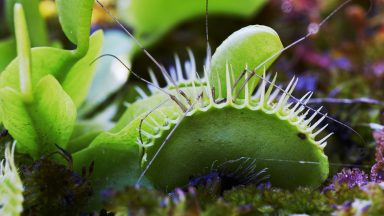
Scientists unlock secret to Venus flytrap’s hair-trigger response
Researchers in Japan have made a significant breakthrough in understanding the Venus flytrap's remarkable ability to capture prey. This carnivorous plant relies on quick electrical impulses generated when its sensitive hairs are touched or stressed. The details of this touch-sensing mechanism, however, have long been a mystery. In their recent study published in Nature Communications, the scientists explored how the Venus flytrap attracts insects with a sweet, fruity aroma. Upon landing on the plant's leaves, an insect stimulates the finely-tuned trigger hairs. When the pressure from the insect's weight bends these hairs sufficiently, the plant snaps its leaves shut, effectively capturing its meal. Once the trap is closed, long cilia within the leaves act like fingers, securing the prey as the plant begins to release digestive enzymes. This digestion process can take anywhere from five to twelve days, culminating in the trap reopening to expel the dried remains of the insect into the air. Notably, a previous study led by biophysicist Rainer Hedrich in 2016 revealed that the Venus flytrap possesses the ability to 'count' the number of touches on its leaves. This counting mechanism is crucial as it allows the plant to differentiate between actual prey and non-prey items, such as small stones or dead insects. The plant registers the first touch but refrains from closing immediately, waiting for a second touch to confirm the presence of genuine prey. It is only after a total of five touches that the trap fully closes and begins the digestion process. In 2023, scientists took a step further by developing a bioelectronic device designed to map the plant's complex signaling pathways. Their findings demonstrated that electrical signals initiate in the sensory hairs and propagate outward in various directions, sometimes even originating from hairs that had not been triggered externally. This research builds on a 2020 study where the same team genetically modified a Venus flytrap to improve understanding of its short-term 'memory.' By introducing a calcium sensor protein known as GCaMP6, which emits a green glow upon binding with calcium, the researchers could visually monitor calcium changes in the plant's cells in response to stimuli. They found that fluctuations in calcium concentration appear to serve as a type of short-term memory for the plant, although the intricacies of how these calcium levels integrate with the plant's electrical signaling remain to be fully elucidated.
TSMC Reports Record 23% Profit Surge Amid AI Chip Demand
Taiwan Semiconductor Manufacturing Company (TSMC) has announced a remarkable 23.4% increase in its second-quarter profit...
CNBC | Jul 16, 2026, 05:45
AI as a Thought Partner: How Leaders are Revolutionizing Decision-Making
In the evolving landscape of artificial intelligence, business leaders are discovering that it serves not just as a prod...
Business Today | Jul 16, 2026, 05:00
Cramer Casts Doubt on Big Tech's Rally Amid Optimism
On Wednesday, CNBC's Jim Cramer expressed skepticism about the recent surge in Big Tech stocks, suggesting that the rall...
CNBC | Jul 15, 2026, 22:55
Jim Cramer Urges Companies to Demonstrate Real Returns from AI Investments
In a recent broadcast, CNBC’s Jim Cramer called for concrete evidence that artificial intelligence is delivering financi...
CNBC | Jul 15, 2026, 23:05
AI's Role in the Workforce: Why Some Jobs Remain Safe from Automation
As artificial intelligence reshapes various industries, the replacement of many front-line workers by robots remains a c...
Business Today | Jul 16, 2026, 02:00