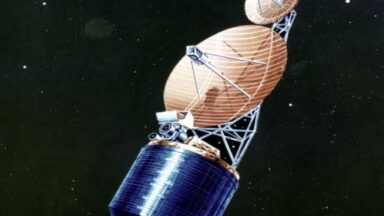
US spy satellite agency declassifies high-flying Cold War listening post
The National Reconnaissance Office (NRO) has made a significant revelation by declassifying details about a covert program that played a crucial role in monitoring Soviet military communications during the Cold War. Known as Jumpseat, this initiative was already somewhat known due to prior leaks and media coverage, but the NRO's latest disclosure sheds light on its detailed objectives, development history, and provides images of the satellites involved. Jumpseat has been described by the NRO as the United States' inaugural highly elliptical orbit (HEO) signals-collection satellite system. Between 1971 and 1987, eight Jumpseat satellites were launched, a time when the NRO's existence was itself a closely guarded state secret. These satellites carried out their operations until 2006, primarily focusing on the surveillance of offensive and defensive weapon systems being developed by adversaries. According to the NRO, the Jumpseat satellites were tasked with collecting electronic emissions, communication intelligence, and foreign instrumentation intelligence. The information gathered was channeled to various entities, including the Department of Defense and the National Security Agency, highlighting the program's vital role in national security. The primary target for these intelligence operations was the Soviet Union. Operating in highly elliptical orbits, the Jumpseat satellites reached altitudes ranging from several hundred miles to 24,000 miles (39,000 kilometers) above the Earth. Their unique flight paths allowed them to spend significant time over the northern hemisphere, particularly above the Arctic, Russia, Canada, and Greenland. This strategic positioning provided continuous coverage over critical areas, especially given that the Soviets had already begun deploying their own communication and early-warning satellites in similar orbits, dubbed Molniya, meaning 'lightning' in Russian. The name Jumpseat itself was first disclosed in a 1986 investigative book by Seymour Hersh, who discussed the Soviet Union's shoot-down of Korean Air Lines Flight 007 in 1983. Hersh noted that the Jumpseat satellites had the capability to intercept a wide range of communications, including voice transmissions between Soviet ground personnel and their pilots, underlining the extent and effectiveness of this significant surveillance initiative.
SpaceX Successfully Tests Starship Rocket, Launching New Era of Space Exploration
On Friday evening, SpaceX executed a significant milestone by launching its colossal Starship rocket from its facility i...
CNBC | Jul 25, 2026, 24:10
Prentis: Ambitious New AI Lab Eyes $100 Million Funding with Innovative Automation Goals
Prentis, a cutting-edge AI research laboratory co-founded by Ritankar Das, Reid Hoffman, and Marc Pincus, is currently i...
TechCrunch | Jul 24, 2026, 22:45
Unveiling the Future of Finance: TechCrunch Disrupt 2026's Smart Money Stage
The landscape of money is transforming beyond just cash or bank balances, and TechCrunch Disrupt 2026 is set to spotligh...
TechCrunch | Jul 24, 2026, 22:40
The High Stakes of Young Entrepreneurship: Balancing Ambition and Pressure
At just 19, Arlan Rakhmetzhanov embodies the relentless spirit of youth entrepreneurship. He believes there’s no in-betw...
TechCrunch | Jul 24, 2026, 17:40
Rising Concerns in Bond Market as AI Investments Surge
Investors are growing increasingly uneasy about the substantial capital required to realize the ambitions of artificial ...
CNBC | Jul 24, 2026, 20:15