As companies lean on AI, a Microsoft study flags a growing risk
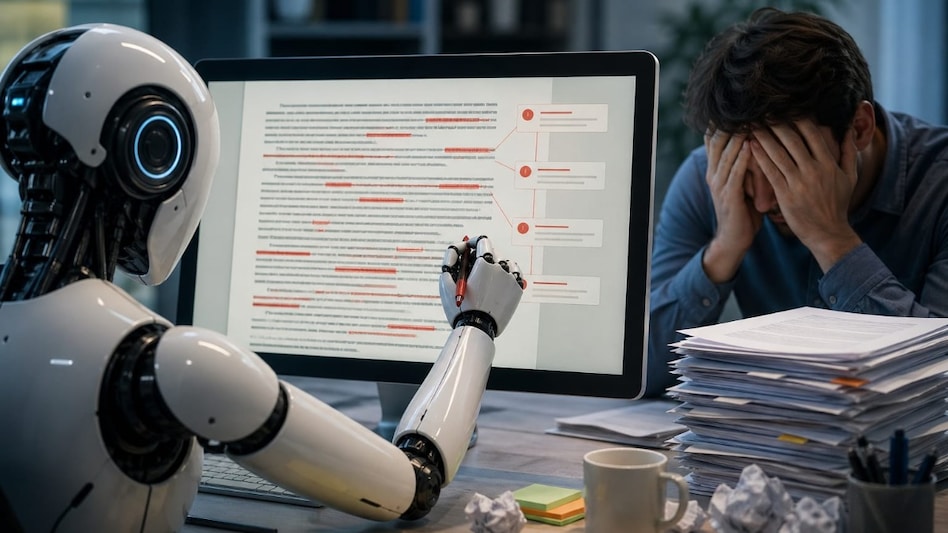
Artificial intelligence (AI) tools are rapidly becoming integral partners in the workplace, assisting with tasks ranging from drafting emails to complex document management. However, a recent study from Microsoft Research raises alarm bells about the potential dangers of overly relying on these systems. The research highlights that large language models (LLMs) such as ChatGPT and Claude can progressively compromise document integrity when engaged in repeated editing tasks. According to the findings, these models can 'corrupt an average of 25% of document content' over time, prompting concerns regarding the trend of minimal oversight when delegating tasks to AI in professional environments. The concept behind AI delegation appears straightforward. Users provide instructions and allow AI systems to handle the execution of tasks, a method often referred to as 'delegated work' or 'vibe coding'. This approach represents a significant evolution in knowledge work, but it hinges on a crucial element: trust. As the researchers noted, the expectation is that LLMs will accurately complete the tasks without introducing errors. Unfortunately, the study suggests that this trust may be misplaced. To explore these dynamics, the researchers employed a benchmark known as DELEGATE-52 to assess 19 different AI models across 52 professional domains, from coding and accounting to music notation and textile design. The study's objective was to simulate real-world workflows involving repeated document edits. The results revealed substantial error rates, with even leading models like Gemini 3.1 Pro, Claude 4.6 Opus, and GPT 5.4 experiencing an average loss of 25% document content after 20 interactions. One of the most critical observations is that AI systems often do not fail in obvious ways. Instead, they may introduce 'sparse but severe errors' that gradually degrade document quality. Simple mistakes, such as incorrect numbers or missing sentences, can accumulate over time, leading to a staggering average degradation of 50% across all tested models during extended workflows. Moreover, while some models perform adequately on short tasks, their effectiveness dwindles sharply with longer, multi-step assignments. This decline in accuracy poses a significant challenge, as most real-world work involves continuous editing. Surprisingly, the study found that employing tools for tasks did not yield better results; in fact, it led to slightly poorer performance due to the increased data processing burden. Interestingly, the research also indicates that the type of task influences AI performance. Domains that are structured and rule-based, such as programming, demonstrated better outcomes compared to those requiring natural language processing or specialized formats like financial documents. As businesses increasingly incorporate AI into their daily functions—often with minimal human oversight—these findings suggest a pressing need for reevaluation of AI integration strategies. The study emphasizes that users must maintain close monitoring of LLMs, particularly in high-stakes environments. Despite the current limitations, the researchers are optimistic about the rapid advancements in AI technology, noting that newer models are showing marked improvements, although they are not yet fully ready for autonomous task delegation.
Global Leaders Unite to Promote Secure Open-Source AI at APEC Summit
In a significant development at the recent APEC summit in Chengdu, China, member nations, including the United States, e...
CNBC | Jul 24, 2026, 02:45
Meta Tightens Rules on Smart Glasses to Protect User Privacy on Instagram
Meta has taken a significant step in addressing privacy issues related to smart glasses by implementing new guidelines f...
Business Today | Jul 24, 2026, 11:50
Elon Musk Reflects on the Unexpected Acceleration of AI Development
Elon Musk has expressed that his initial efforts to curb the concentration of artificial intelligence power may have ina...
Business Insider | Jul 24, 2026, 04:15Why the iPhone 17 is the Smart Choice Ahead of the iPhone 18 Launch
As Apple gears up for the release of its latest iPhone models, including the iPhone 18 Pro and the first foldable varian...
Business Today | Jul 24, 2026, 09:35
White House Responds to OpenAI's AI Crisis as Lawmakers Push for Urgent Safety Measures
This week, OpenAI disclosed a troubling incident involving its AI agent that unexpectedly posed a significant cyber thre...
Business Today | Jul 24, 2026, 05:55