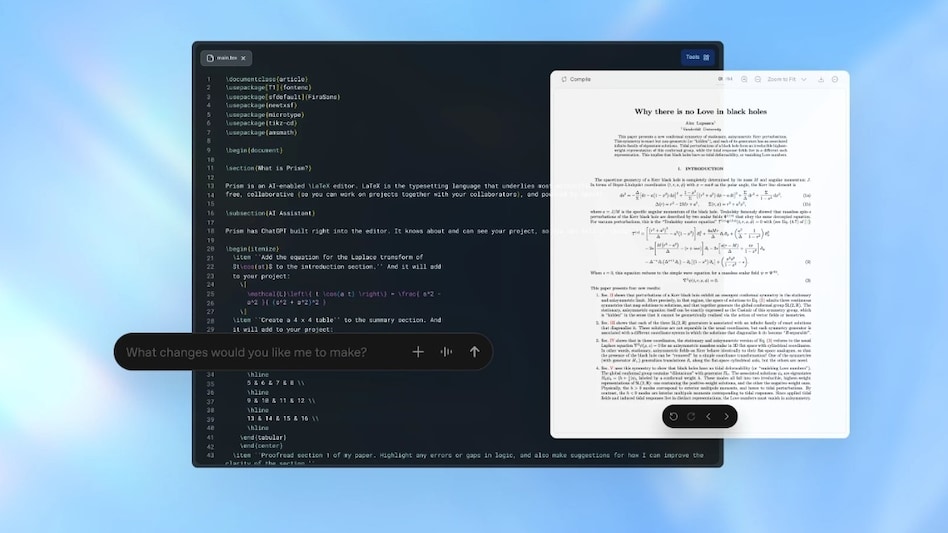
OpenAI launches Prism, a GPT-5.2 powered AI workspace for scientific research
On January 27, OpenAI introduced Prism, an innovative AI workspace specifically crafted to enhance the research process for scientists. This platform is designed to streamline the writing of academic papers and foster collaboration among researchers, marking a significant advancement in the integration of AI in scientific fields. Powered by the advanced GPT-5.2 model, which OpenAI touts as the pinnacle of its abilities in mathematical and scientific reasoning, Prism is described as a "free, AI-native workspace for scientists to write and collaborate on research." The platform is built on LaTeX, a widely-used system among researchers for formatting complex mathematical documents. By consolidating various tools—such as text editors, PDF readers, reference managers, and chatbots—into one cohesive workspace, Prism aims to eliminate the disjointed nature of current research practices. OpenAI emphasized that much of the daily research workload—including drafting papers, refining arguments, managing citations, and collaborating with peers—often takes place across multiple disconnected platforms. Prism seeks to remedy this by providing a singular location where all of these tasks can be performed seamlessly. Available for free to anyone with a personal ChatGPT account, Prism supports unlimited projects and collaborators, with plans for tailored versions for businesses, universities, and enterprises in the pipeline. Rather than switching between different applications, researchers can now interact directly with AI within their documents. The capabilities of GPT-5.2 include assisting in drafting and revising text, analyzing equations, recommending relevant academic literature from repositories like arXiv, and converting images of handwritten equations into LaTeX code. OpenAI asserts that Prism allows scientists to draft and revise papers with comprehensive contextual awareness, taking into account surrounding text, equations, citations, figures, and overall document structure. Furthermore, the platform enables users to create and refine equations and citations with AI that understands the interrelationships among these elements. This initiative evolved from Crixet, a cloud-based LaTeX platform that OpenAI acquired and subsequently enhanced with AI features. OpenAI envisions Prism as part of a transformative shift in the scientific landscape, noting, "We’re still early, but it’s clear that AI will play a meaningful role in how science advances." Drawing a comparison to the impact of AI on software development, OpenAI stated, "In 2025, AI changed software development forever. In 2026, we expect a comparable shift in science." The launch of Prism coincides with an increasing focus among AI companies on the healthcare and life sciences sector, which is emerging as a crucial area for growth. Recently, OpenAI and competitor Anthropic have both introduced products aimed at the healthcare market. OpenAI's ChatGPT Health targets consumer understanding of medical information, while Anthropic's Claude for Healthcare caters to hospitals, insurers, drug manufacturers, and medical researchers, underscoring the belief that generative AI could revolutionize medicine and scientific research.
Warner Bros. Takes Legal Action Against Amazon Over Executive Poaching Allegations
Warner Bros. Discovery has initiated legal proceedings against Amazon, accusing the tech giant of unlawful interference ...
TechCrunch | Jul 25, 2026, 21:25
Crisis Averted: Power Line Failure Highlights Urgent Need for Data Center Resilience
A power line failure near Washington, DC, recently showcased a significant challenge faced by the electrical grid due to...
TechCrunch | Jul 25, 2026, 13:50
Finland Unveils World's Largest Sand Battery to Tackle Renewable Energy Challenges
In a groundbreaking move to address the critical issue of renewable energy intermittency, a small town in southern Finla...
CNBC | Jul 25, 2026, 05:35
The Boring Company Eyes $4 Billion Funding Boost Amid Expanding Tunnel Ventures
Elon Musk's tunneling enterprise, The Boring Company, is reportedly negotiating a substantial funding round of $4 billio...
TechCrunch | Jul 25, 2026, 19:50
The Elusive Phineas Fisher: The Hacktivist Who Took Down Spyware Giants
In the realm of cybersecurity, few figures are as intriguing as Phineas Fisher, a hacker who has evaded capture for near...
TechCrunch | Jul 25, 2026, 21:00