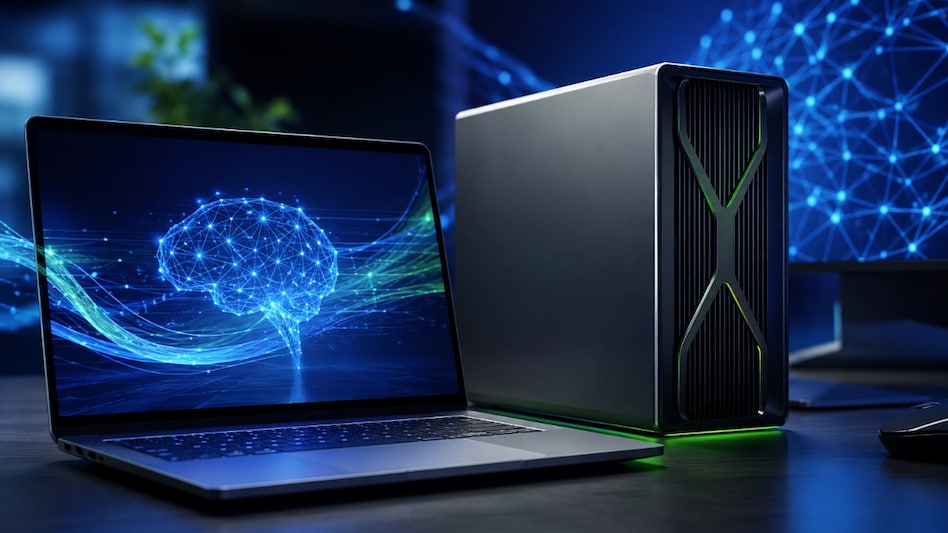
What is an AI PC and why is Nvidia betting on it?
Artificial intelligence (AI) is revolutionizing various sectors, and now Nvidia aims to integrate this technology directly into personal computers. During the Computex event in Taiwan, Nvidia's CEO Jensen Huang introduced RTX Spark, a cutting-edge AI chip developed in collaboration with MediaTek. This innovative chip is designed to support AI applications and autonomous agents on both laptops and desktops. As the demand for AI-enhanced computers fluctuates, manufacturers are actively seeking new avenues for growth. But what exactly defines an AI PC, and why are tech giants like Nvidia, Microsoft, HP, and Dell heavily investing in this emerging category? An AI PC is engineered to process AI tasks locally rather than depending on cloud-based systems. Unlike standard computers, AI PCs can execute AI assistants, chatbots, and other machine learning applications directly on the device. This capability minimizes reliance on remote servers, leading to improved response times and reduced internet connectivity needs for specific operations. The key differentiator between AI PCs and conventional computers is the inclusion of a dedicated Neural Processing Unit (NPU). This specialized chip is tailored for AI functions and works in conjunction with the central processing unit (CPU) and graphics processing unit (GPU) to enhance AI performance while being energy efficient. These processors excel at tasks such as language processing, image generation, real-time transcription, and various machine-learning applications. Nvidia is pushing for the adoption of AI PCs now because it anticipates that the next surge of AI usage will occur on personal devices. The RTX Spark platform is designed to operate AI agents locally, performing tasks with minimal human intervention—such as conducting information searches, organizing files, drafting written content, or managing workflows across multiple applications. By enabling on-device operations, Nvidia aims to lessen reliance on cloud services while ensuring faster responsiveness and better data management. The market response to AI PCs has been mixed. HP reported that AI-enabled computers made up 44% of its PC shipments in the last quarter, a rise from over 35% the previous quarter, highlighting a positive trend in demand. However, Dell expressed that the anticipated surge in demand for AI PCs had not materialized as expected. Several manufacturers are gearing up to release AI PCs powered by the RTX Spark, including ASUS, Dell, HP, Lenovo, Microsoft, and MSI, with more products anticipated from Acer and Gigabyte. Additionally, Microsoft and Qualcomm have already launched Copilot+ PCs, which are specifically designed for on-device AI processing. Despite the excitement surrounding AI PCs, challenges loom on the horizon. Analysts warn that the increasing demand for AI infrastructure is straining the supply of crucial memory components like DRAM and NAND flash. This shortage is leading to rising costs, which could impact the pricing of devices amid efforts to encourage consumer upgrades. Lastly, privacy concerns surrounding AI PCs cannot be overlooked. Microsoft faced backlash in 2024 after introducing a feature called Recall, which documented user activity and created a searchable log of actions on the device. Critics raised alarms about the volume of data being collected, prompting Microsoft to delay the feature's rollout and implement enhanced security measures before offering it to a limited user base.
SpaceX Successfully Tests Starship Rocket, Launching New Era of Space Exploration
On Friday evening, SpaceX executed a significant milestone by launching its colossal Starship rocket from its facility i...
CNBC | Jul 25, 2026, 24:10
The Rise of AI Distillation: A Controversial Technique Sparks Debate in Tech and Government
In recent discussions, a once-obscure topic in artificial intelligence has surged to the forefront of debates among tech...
CNBC | Jul 25, 2026, 12:15
The Boring Company Eyes $4 Billion Funding Boost Amid Expanding Tunnel Ventures
Elon Musk's tunneling enterprise, The Boring Company, is reportedly negotiating a substantial funding round of $4 billio...
TechCrunch | Jul 25, 2026, 19:50
Market Turbulence: Four Key Factors Impacting Stocks This Week
This past week has been challenging for the stock market, driven by several significant forces that have created turbule...
CNBC | Jul 25, 2026, 20:05
Kalshi Challenges Netflix Over Controversial Documentary Trailer
Kalshi, the prediction market platform, has taken significant legal steps against Netflix, sending a cease-and-desist le...
TechCrunch | Jul 25, 2026, 17:10