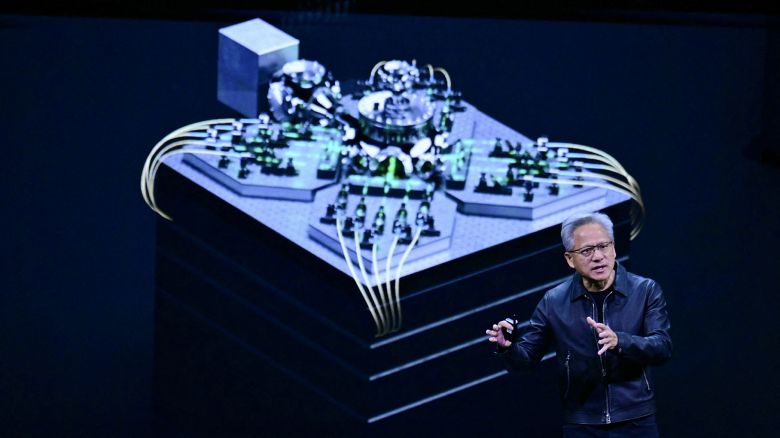
The world’s most valuable public company just laid out its vision for the future
Nvidia, the foremost leader in artificial intelligence chip technology, is set to expand its influence across various sectors of daily life. In a landmark keynote at the GTC AI conference in Washington, D.C., CEO Jensen Huang laid out a comprehensive vision that encompasses everything from telecommunications to advanced robotics and autonomous vehicles. As AI continues to increasingly permeate everyday activities and the global economy, Nvidia aims to solidify its position in a competitive tech landscape. The company, which recently achieved a staggering $4 trillion valuation and has established partnerships with major corporations, faces significant challenges including market bubble concerns and rising competition from chip manufacturers like AMD and Qualcomm. In an assertive move, Nvidia announced the introduction of a detailed framework for developing extensive "gigascale" AI data centers, dubbed "AI factories." This initiative is expected to attract substantial investments from tech giants such as Oracle, Microsoft, and Google. The company also revealed plans for a new AI Factory Research Center in Virginia, which will integrate its leading-edge chips and software. Moreover, Nvidia is collaborating with T-Mobile and Nokia to launch "AI-native" 6G cell phone towers, utilizing a new product called the Aerial RAN computer. This advancement promises to deliver enhanced connectivity for smartphones and various AI-powered devices, including smart speakers and potentially robots, marking a significant leap towards the next generation of wireless technology. Looking ahead, Nvidia has set ambitious targets, including a partnership with Uber to produce 100,000 self-driving cars by 2027. These vehicles will be equipped with Nvidia's advanced chips and the proprietary DriveOS, enabling broader access to autonomous transportation. In the realm of enterprise solutions, Nvidia is providing computing power and AI models to companies like Palantir, helping them automate processes and improve efficiency. For instance, Lowe's will leverage this technology to create a digital representation of its supply chain, identifying areas for cost savings. Additionally, Nvidia is working with Siemens to develop "digital twins" for robotic factories, a technology designed to enhance the design, operation, and monitoring of robots in hazardous jobs, while also addressing labor shortages in manufacturing. In collaboration with the U.S. Department of Energy, Nvidia is set to build seven new quantum supercomputers, further positioning itself as a key player in scientific advancement. Despite Nvidia's optimistic portrayal of the current AI era as a new industrial revolution, a recent MIT report indicates that many companies are yet to see a return on their AI investments. The keynote's setting in Washington, D.C., underscores Huang's influential role in shaping U.S. AI policy, particularly in alignment with President Trump's agenda to enhance national manufacturing capabilities. Huang's remarks echoed this sentiment, emphasizing the importance of domestic production for national security. As Nvidia navigates its path forward, it remains committed to pushing the boundaries of what AI can achieve across multiple industries.
Global AI Race Heats Up: Macron and Modi Engage Tech Giants for Investment
In a bid to lead the global AI frontier, French President Emmanuel Macron and Indian Prime Minister Narendra Modi are ac...
CNBC | Jul 04, 2026, 05:20
Alibaba Takes Stand Against Claude Code: Employees Directed to Use Qoder
In a notable move within the tech industry, Alibaba has announced that it will prohibit its employees from utilizing Ant...
TechCrunch | Jul 04, 2026, 16:55
Tech Job Market Thrives Amidst AI Revolution: Demand for Skills Shifts
A recent study by Draup, a labor and market data platform, reveals that while artificial intelligence (AI) is transformi...
Business Insider | Jul 03, 2026, 20:40AI Stock Surge: What's Next for Investors in a Holiday Week?
The stock market experienced a notable shift during the holiday-shortened week, with investors eagerly scouting for the ...
CNBC | Jul 03, 2026, 16:05
Why Chevy's Silverado EV Isn't Gaining Traction in the Market
Growing up, I often reminisced about riding in my dad's Chevrolet S-10 pickup truck, yet I never thought I'd be the targ...
TechCrunch | Jul 03, 2026, 16:55