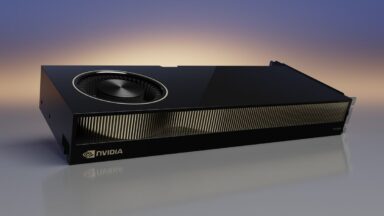
Nvidia chips become the first GPUs to fall to Rowhammer bit-flip attacks
Nvidia has issued guidance for users of one of its GPU product lines, advising them of a necessary mitigation that could lead to a performance reduction of up to 10 percent. This preventive measure aims to shield customers from potential exploits that could compromise their work and data integrity. The recommendation follows a demonstration by a group of academic researchers who successfully executed an attack on Nvidia’s RTX A6000. This GPU, widely utilized for high-performance computing and available through numerous cloud platforms, was shown to be vulnerable to Rowhammer—a type of attack that exploits inherent weaknesses in DRAM chip modules. Rowhammer attacks manipulate data stored in memory by repeatedly accessing—effectively 'hammering'—specific rows of memory cells. This process can cause bit flips in adjacent rows, converting digital zeros to ones and vice versa. While Rowhammer had previously only been demonstrated against memory chips in CPUs, the recent research unveiled GPUhammer, marking the first successful Rowhammer exploit on a discrete GPU. Traditionally, GPUs have been leveraged for graphics rendering and password cracking. However, their role has evolved significantly, becoming crucial in high-performance computing, machine learning, and various AI applications. Nvidia, a key player in this AI and HPC surge, recently marked a historic milestone by achieving a $4 trillion valuation. Though the researchers tested their exploit only on the A6000, they suggested that other Nvidia GPUs could also be susceptible to this attack. Their proof-of-concept exploit was capable of interfering with deep neural network models that are vital in machine learning applications, including autonomous driving, healthcare diagnostics, and MRI image analysis. The GPUHammer attack can flip a single bit in a model weight's exponent, which could drastically alter its value—potentially by 128 times—leading to a significant drop in model accuracy from 80 percent to a mere 0.1 percent, as explained by Gururaj Saileshwar, an assistant professor at the University of Toronto and co-author of the research paper outlining the attack.
Return to Westeros: A Knight of the Seven Kingdoms Captivates Audiences
HBO has once again struck gold with its latest series, A Knight of the Seven Kingdoms, which draws inspiration from Geor...
Ars Technica | Feb 23, 2026, 13:55
The Rise of AI: Robots Predicted to Surpass Human Workers by 2050
In a striking forecast, a former executive from Citigroup has warned that within the next few decades, artificial intell...
CNBC | Feb 23, 2026, 14:35
IQM Set to Revolutionize Quantum Sector with Upcoming Public Listing Valued at $1.8 Billion
Finland's quantum computing startup IQM has announced its ambitious plan to become one of the first publicly traded comp...
CNBC | Feb 23, 2026, 12:15
Market Insights: Tariff Shifts, Winter Weather Disruptions, and OpenAI's Financial Forecast
As the Winter Olympics conclude, athletes depart Italy with more than medals, while stock futures dip following a succes...
CNBC | Feb 23, 2026, 13:35
Finnish Quantum Computing Pioneer IQM Plans Public Offering Amid Market Surge
Finnish quantum computing firm IQM has revealed its intention to go public through a special purpose acquisition company...
TechCrunch | Feb 23, 2026, 16:50