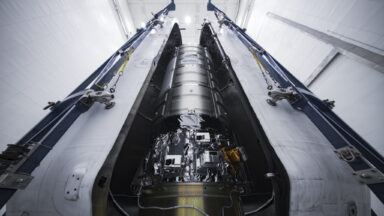
Northrop Grumman’s new spacecraft is a real chonker
In a groundbreaking mission, Northrop Grumman's upgraded Cygnus spacecraft made its debut aboard a SpaceX Falcon 9 rocket, setting a record for the heaviest resupply mission to the International Space Station (ISS). Launched from Cape Canaveral Space Force Station in Florida on Sunday evening, the mission, designated NG-23, is expected to reach the ISS early Wednesday, delivering an impressive 10,827 pounds (4,911 kilograms) of essential cargo to support the lab and its crew of seven. NASA astronaut Jonny Kim will utilize the Canadian-built robotic arm on the space station to capture the Cygnus cargo ship upon its arrival, subsequently securing it to a port for the crew to begin unloading its valuable contents. The Cygnus XL, a larger version of previous models, boasts significant enhancements, including a service module produced in Northrop's Virginia factory, which provides the spacecraft with necessary power and propulsion. Visually, the Cygnus XL retains the familiar design of earlier missions, featuring its distinctive circular solar arrays and a pressurized cargo module, which has been extended to 5.2 feet (1.6 meters) longer than its predecessors. According to Ryan Tintner, vice president of civil space systems at Northrop Grumman, the spacecraft's overall size is comparable to two Apollo command modules, with the cargo capacity equivalent to that of two-and-a-half minivans. Tintner emphasized the significance of the Cygnus XL configuration, which offers a 33% increase in capacity compared to earlier versions. This enhancement allows for the delivery of more scientific equipment and cargo per launch, thereby reducing the cost per kilogram for NASA. The cargo modules are manufactured by Thales Alenia Space in Turin, Italy, utilizing a design reminiscent of the permanent modules already in use on the space station. The successful launch comes after a previous cargo module was unfortunately damaged during transport from Italy earlier this year.
Nvidia's Jensen Huang Calls for a More Balanced AI Narrative Amid Growing Public Concerns
In a recent interview, Nvidia's CEO Jensen Huang urged leaders in the artificial intelligence sector to adopt a more con...
Business Insider | Jul 24, 2026, 09:50Elon Musk Reflects on the Unexpected Acceleration of AI Development
Elon Musk has expressed that his initial efforts to curb the concentration of artificial intelligence power may have ina...
Business Insider | Jul 24, 2026, 04:15Global Leaders Unite to Promote Secure Open-Source AI at APEC Summit
In a significant development at the recent APEC summit in Chengdu, China, member nations, including the United States, e...
CNBC | Jul 24, 2026, 02:45
Elon Musk's Ambitious Leap: Can Tesla's Optimus Robot Revolutionize Work and Life?
Elon Musk has transformed Tesla into a leading automotive giant, but now he is staking the company's future on a groundb...
Business Insider | Jul 24, 2026, 09:10AI Guardrails: A Double-Edged Sword for Cybersecurity Researchers
In recent months, leading AI companies have implemented stringent regulations and vetted programs to curb potential misu...
TechCrunch | Jul 24, 2026, 01:15