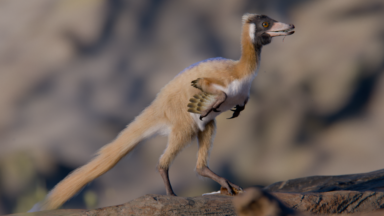
Tiny, long-armed dinosaur leads to rethink of dinosaur miniaturization
Recent research has unveiled a fascinating discovery that may shift our understanding of dinosaur evolution, particularly regarding the alvarezsaurids—small-bodied theropods once thought to be primitive flightless birds. Initially, paleontologists believed these creatures evolved to become smaller as an adaptation for hunting social insects like ants and termites. This idea proposed a straightforward evolutionary path: a reduction in size for improved hunting efficiency. However, the unearthing of a new fossil belonging to one of the tiniest alvarezsaurids, named Alnashetri cerropoliciensis, suggests that the trajectory of miniature dinosaurs may be more complex than previously thought. Contrary to earlier assumptions, this species likely did not prey on ants. According to Peter Makovicky, a paleontologist from the University of Minnesota, Alnashetri cerropoliciensis was a pursuit predator that actively hunted a variety of insects and small mammals. Alvarezsaurids, primarily found in the Late Cretaceous deposits of Asia and South America, are characterized by their short forelimbs ending in a distinctive oversized thumb claw, ideal for digging. They also featured tiny teeth and sensory adaptations similar to those seen in contemporary nocturnal birds, which were believed to facilitate their specialization in foraging on termite mounds. The newly discovered fossil, unearthed from the Candeleros Formation in Río Negro Province, Argentina, dates back approximately 90 million years and represents the most complete and smallest alvarezsaurid skeleton found in South America. While the specimen is missing parts of its skull, arm, leg, and tail, it retains significant anatomical features. Notably, the bone tissue indicates that this individual was a subadult, nearing sexual maturity, as suggested by the presence of medullary bone, a temporary tissue linked to egg-laying in modern birds. Despite nearing full growth, this tiny dinosaur weighed an estimated 700 grams, highlighting the extraordinary diversity and adaptability of these ancient creatures.
Shifting Focus: The Cost-Effectiveness of AI Models Takes Center Stage
In recent years, the AI sector has been intensely focused on identifying the most advanced models. While this pursuit re...
Business Insider | Jul 25, 2026, 13:10Nvidia Strikes Major Deal with SK Hynix to Secure AI Memory Supply
Nvidia has successfully forged a significant partnership with South Korea's SK Hynix to secure memory supplies essential...
CNBC | Jul 25, 2026, 05:15
SpaceX Successfully Tests Starship Rocket, Launching New Era of Space Exploration
On Friday evening, SpaceX executed a significant milestone by launching its colossal Starship rocket from its facility i...
CNBC | Jul 25, 2026, 24:10
Unlocking the Secrets of Quantum Gravity: Can AI Help Physics Make a Leap?
The realm of scientific research is undergoing a profound transformation, fueled by the rapid advancements in artificial...
Business Today | Jul 25, 2026, 24:30
Vision Breakthrough: US Startup Launches Groundbreaking Retina Chip in Europe
Science Corp is poised to introduce a revolutionary retina chip in Europe, designed to restore partial vision for indivi...
Business Today | Jul 25, 2026, 01:00