Study confirms Romans used “hot mixing“ to make concrete
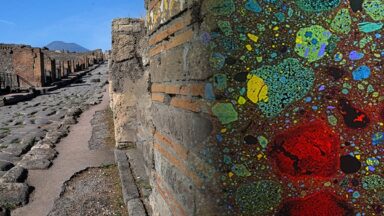
Recent research has reaffirmed that the ancient Romans utilized an innovative method known as "hot mixing" with quicklime in their concrete production, granting the material unique self-healing properties. This revelation comes from MIT scientists who previously noted discrepancies between historical texts and actual Roman concrete recipes. The team's latest paper, published in the journal Nature Communications, analyzes samples from a newly uncovered archaeological site, confirming that the Romans indeed employed this advanced technique. Ancient Roman concrete, akin to modern Portland cement, was a mixture of a semi-liquid mortar combined with aggregates, but its composition included larger, fist-sized stones or bricks. Roman architect Vitruvius, in his work De architectura from around 30 CE, described the construction of durable concrete walls for funerary structures, advocating for walls of at least two feet thick made from squared red stones, bricks, or lava laid in layers. He emphasized that the mortar should consist of hydrated lime and volcanic tephra—fragments of glass and crystals from eruptions—ensuring long-lasting integrity. Admir Masic, an environmental engineer at MIT, has dedicated years to exploring the properties of ancient Roman concrete. His efforts include developing advanced analytical tools like Raman spectroscopy and multi-detector energy dispersive spectroscopy, which allow for detailed analysis of concrete samples. Masic's previous work includes an examination of concrete from the Tomb of Caecilia Metella, a notable mausoleum along the historic Appian Way. In their 2023 analysis, Masic and his team took a closer look at peculiar white mineral formations known as "lime clasts," which had previously been dismissed as indicators of poor material quality. Their findings suggest that these clasts were purposefully integrated into the concrete mix. When cracks occur in the concrete, they tend to propagate through these lime clasts, which can react with water to form a calcium-rich solution. This solution either recrystallizes as calcium carbonate to mend the cracks or interacts with other components to enhance the material's overall strength.
Crisis Averted: Power Line Failure Highlights Urgent Need for Data Center Resilience
A power line failure near Washington, DC, recently showcased a significant challenge faced by the electrical grid due to...
TechCrunch | Jul 25, 2026, 13:50
Prentis: Ambitious New AI Lab Eyes $100 Million Funding with Innovative Automation Goals
Prentis, a cutting-edge AI research laboratory co-founded by Ritankar Das, Reid Hoffman, and Marc Pincus, is currently i...
TechCrunch | Jul 24, 2026, 22:45
Waymo Considers Parting Ways with Uber Amid Rising Tensions
Waymo is reportedly exploring options to exit its partnership with Uber, which has allowed the Alphabet-owned firm to de...
TechCrunch | Jul 24, 2026, 21:00
Vietnam's Controversial Social Media Proposal: A New Approach for Youth Engagement
Vietnam is contemplating a distinctive approach to youth social media regulations, diverging from the more common outrig...
TechCrunch | Jul 24, 2026, 21:25
Waymo to Launch Standalone App, Ending Exclusivity with Uber in Major Cities
For the past three years, Uber and Waymo, the autonomous vehicle division of Alphabet, have collaborated to provide driv...
CNBC | Jul 24, 2026, 21:55