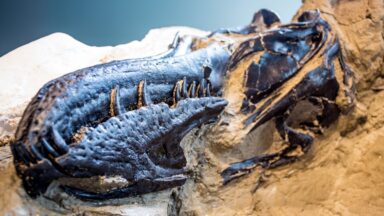
Nanotyrannusspecies confirmed: It’s not just a babyT-rex
After four decades of heated debate among paleontologists regarding the classification of certain rare fossils, clarity has finally emerged. A new study published in the journal *Nature* asserts that these fossils represent a separate species known as Nanotyrannus lancensis, effectively settling a long-standing controversy. The research not only affirms the existence of Nanotyrannus as a legitimate taxon, but it also introduces a second new species distinct from N. lancensis. "This fossil doesn’t just settle the debate," stated Lindsay Zanno, a paleontologist at North Carolina State University and head of paleontology at the North Carolina Museum of Natural Sciences. "It flips decades of T. rex research on its head." Historically, paleontologists relied on these fossils to understand the growth and behavior of Tyrannosaurus rex. The findings hint at the possibility of multiple species within the tyrannosaur family, suggesting that previous assessments may have underestimated the diversity of dinosaurs from that era. The story traces back to 1942 when the fossilized skull of a Nanotyrannus, affectionately dubbed 'Chomper,' was unearthed in Montana by a Cleveland Museum of Natural History team. Initially misclassified as a Gorgosaurus, the identification faced scrutiny in 1965 when it was proposed to be a juvenile T. rex. It wasn't until 1988 that scientists suggested it was a new species altogether. Debate persisted, with a notable paper in 2020 asserting that Nanotyrannus was simply a juvenile T. rex. However, many paleontologists maintained that it deserved classification as a distinct species. A January 2024 study reinforced this stance, with co-authors Nicholas Longrich and Evan Saitta analyzing the growth rings in Nanotyrannus bones, indicating that these creatures were nearly fully grown. Additionally, they found no hybrid fossils exhibiting traits of both Nanotyrannus and T. rex, which would be expected if the former were merely a juvenile of the latter. Their research included a comparison with a juvenile T. rex skull bone, revealing that Nanotyrannus had a lighter build, longer limbs, and larger arms, likely making it smaller, faster, and more agile than T. rex.
Warner Bros. Takes Legal Action Against Amazon Over Executive Poaching Allegations
Warner Bros. Discovery has initiated legal proceedings against Amazon, accusing the tech giant of unlawful interference ...
TechCrunch | Jul 25, 2026, 21:25
Navigating the Future: Are Wearable AI Gadgets Ready to Transform Our Lives?
Imagine a typical workday where you and your colleagues sport discreet recorders on your clothing, while smart glasses s...
CNN | Jul 26, 2026, 16:10
The Boring Company Eyes $4 Billion Funding Boost Amid Expanding Tunnel Ventures
Elon Musk's tunneling enterprise, The Boring Company, is reportedly negotiating a substantial funding round of $4 billio...
TechCrunch | Jul 25, 2026, 19:50
Shifting Focus: The Cost-Effectiveness of AI Models Takes Center Stage
In recent years, the AI sector has been intensely focused on identifying the most advanced models. While this pursuit re...
Business Insider | Jul 25, 2026, 13:10Kalshi Challenges Netflix Over Controversial Documentary Trailer
Kalshi, the prediction market platform, has taken significant legal steps against Netflix, sending a cease-and-desist le...
TechCrunch | Jul 25, 2026, 17:10