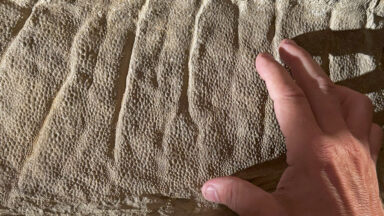
Wyoming dinosaur mummies give us a new view of duck-billed species
A significant paleontological breakthrough has emerged from Wyoming, where researchers have unveiled new details about the Edmontosaurus annectens, a large duck-billed dinosaur that roamed the Earth during the late Cretaceous period. Initially discovered in 1908 by fossil collector C.H. Sternberg, the original skeleton, now known as the 'AMNH mummy' and displayed at the American Museum of Natural History, provided an early glimpse into the creature's appearance through its scaly skin impressions found in the sediment. More than a century after Sternberg's find, a team led by Paul C. Sereno, a professor at the University of Chicago, returned to the site of the original excavation. Their efforts yielded two additional Edmontosaurus mummies, preserving intricate details of the dinosaur's external anatomy within a fine layer of clay. This groundbreaking discovery offers an unprecedented look at the physical characteristics of Edmontosaurus, including the specific size of its scales and the arrangement of its tail spikes. The image of Edmontosaurus has evolved significantly since the initial artistic rendering by famous paleoartist Charles R. Knight in 1909, which was based on Sternberg's original specimen. Sereno points out that Knight's depiction inaccurately extended the crest along the entire body, as the model he used lacked a tail, leading the artist to fill in the blanks with imaginative interpretations. In 1984, paleontologist Jack Horner revised Knight's illustration after discovering a tail section adorned with spikes instead of a crest. However, due to the specimen's preparation inaccuracies, Horner mistakenly believed the spikes were rectangular and incorrectly extended them from the tail to the head in his reconstruction. Sereno asserts that the new findings allow for a clearer, more accurate visualization of Edmontosaurus, stating, 'I think now we finally nailed down the way it truly looked.' This research not only corrects past misconceptions but also enhances our understanding of this fascinating dinosaur species.
Unlock the Full Potential of Your Google Pixel: 5 Essential Features to Activate
Google Pixel smartphones are celebrated not only for their impressive cameras and sleek designs but also for their robus...
Business Today | Jul 20, 2026, 10:00
Boeing's Strategic Shift in Aircraft Development: Insights and Caution Ahead of Earnings
Boeing is making notable strides in its aircraft development strategy, embracing modern approaches that reflect changing...
CNBC | Jul 20, 2026, 16:25
Hugging Face Confirms Cyberattack: Internal Datasets Compromised, Users Advised to Act
Hugging Face, a prominent platform for AI models and datasets, has reported a significant security breach that affected ...
TechCrunch | Jul 20, 2026, 13:10
Cybersecurity Alert: Millions of WordPress Sites at Risk from Exploited Vulnerabilities
Recent cybersecurity reports indicate that hackers are actively targeting websites that utilize outdated versions of the...
TechCrunch | Jul 20, 2026, 15:55
AMD Unveils Helios: A Bold Challenge to Nvidia's AI Dominance with Microsoft on Board
After a notable resurgence, Advanced Micro Devices (AMD) is set to launch Helios, its inaugural rack-scale system design...
CNBC | Jul 20, 2026, 13:35