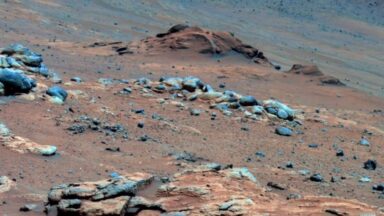
A new Martian climate model suggest a mostly cold, harsh environment
Researchers have made significant strides in understanding Mars' climate history, revealing that the planet may have been predominantly cold and inhospitable. The Curiosity rover, during its ascent of Mount Sharp—the largest sedimentary structure on Mars—gathered valuable samples suggesting that carbon dioxide from the Martian atmosphere may have been trapped in sedimentary rocks, similar to limestone formations on Earth. This process could have effectively reduced atmospheric carbon dioxide levels, leading to a decrease in the greenhouse effect that once warmed the planet. A team of scientists, led by Benjamin Tutolo from the University of Calgary, utilized data from these samples to propose a carbon cycle on Mars that could account for the existence of liquid water on its surface. Expanding on this foundational research, another group spearheaded by Edwin Kite, a planetary science professor at the University of Chicago and a member of the Curiosity science team, has developed a groundbreaking climate model. This model incorporates new findings alongside Martian topography, solar luminosity, and the latest orbital data to simulate the evolution of Mars' conditions and landscape over an astonishing 3.5 billion years. The results of this advanced modeling indicate that any potential Martian life forms would have faced extreme challenges in their survival. Unlike previous models that treated Mars as a single pixel over extended timescales, Kite's team created a spatially resolved model that accurately reflects the planet's diverse geography, including its hills, mountains, and riverbeds. "To the best of my knowledge, we built the first spatially resolved, long-term climate evolution model for Mars," Kite stated. The model begins its simulation 3.5 billion years ago, during a crucial phase that Kite refers to as the 'era of salts.' This innovative approach not only enhances our understanding of Mars but also opens new avenues for future research into the planet's climate dynamics.
Amazon Unleashes Alexa+: A Smarter AI Assistant for All U.S. Users
Amazon has officially launched Alexa+, the enhanced version of its popular AI assistant, making it accessible to all U.S...
TechCrunch | Feb 04, 2026, 14:10
AI Revolution: Former Meta Engineer Reflects on the Future of Coding
As the world of technology continues to evolve, global software stocks experienced a significant drop on February 3, dri...
Business Today | Feb 04, 2026, 12:35
NASA's SLS Rocket: A Long Journey Marked by Delays and High Costs
The Space Launch System (SLS) rocket program has been in development for over 15 years, and it is plagued by two signifi...
Ars Technica | Feb 04, 2026, 14:50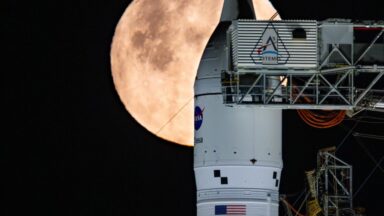
Anthropic Stands Firm: Claude Chatbot Remains Ad-Free Amid Industry Shift
In a bold move, Anthropic announced on Wednesday that its AI chatbot, Claude, will not feature advertisements, directly ...
CNBC | Feb 04, 2026, 15:00
Spotify Enhances Lyrics Feature with Offline Access and Global Translations
On Wednesday, Spotify unveiled significant upgrades to its in-app lyrics feature, allowing users to access lyrics even w...
TechCrunch | Feb 04, 2026, 13:35