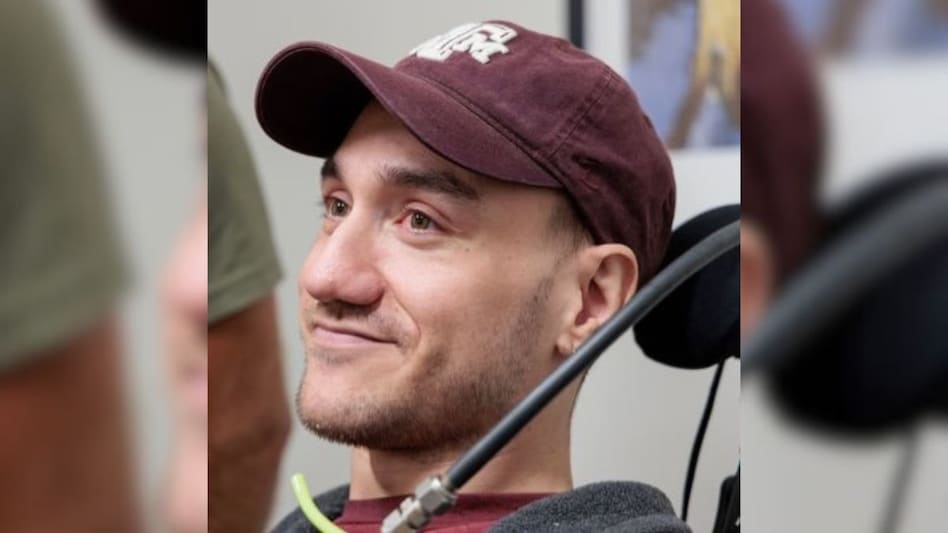
'I have potential again': First Neuralink patient says chip has given him new independence
After eighteen months of being the first recipient of Elon Musk’s Neuralink brain implant, Noland Arbaugh has shared how this innovative device has significantly changed his life. The implant has granted him newfound independence and a revitalized sense of purpose. Arbaugh, who is now 31, faced paralysis from the shoulders down due to a swimming accident in 2016, which left him without movement or sensation below the injury. In 2024, he underwent a pioneering surgery where a robotic system implanted the Neuralink device into his brain. This coin-sized chip connects over a thousand tiny electrodes to his neurons, enabling the device to detect and interpret electrical signals and convert them into digital commands. With this brain-computer interface (BCI), Arbaugh can now control a computer cursor with his thoughts, type on a screen, and interact with various connected devices. He reports using the system for up to ten hours daily, which allows him to pursue studies, read, and even enjoy video games like Mario Kart. Furthermore, he utilizes the technology to operate everyday electronics, such as his television and air purifier, broadening his horizons. Arbaugh has enrolled in a community college in Arizona and is considering starting his own business, in addition to engaging in paid speaking opportunities. "I feel like I have potential again," he expressed. "I guess I always had it, but now I'm discovering how to fulfill that potential in significant ways." However, his journey has not been entirely straightforward. Shortly after the implant was placed, some of the device’s ultrafine threads retracted from his brain tissue, diminishing its initial functionality. Arbaugh opted not to disclose this issue at the time, believing it could undermine confidence in the project before Neuralink's engineers could address it. Fortunately, the device was recalibrated, restoring much of its initial performance. Before receiving the implant, Arbaugh described his life as lacking direction, stating, "I would stay up all night and sleep all day, and I didn’t want to inconvenience anyone or disrupt any plans." Now, he feels empowered and motivated, even acknowledging the risks involved from the beginning. "I decided that, even if it didn’t work—even if something went terribly wrong—I knew it would benefit someone in the future." Reflecting on his transformative experience, Arbaugh humorously noted that the implant technically makes him a cyborg, but he sees himself as just a regular guy. Founded by Musk in 2016, Neuralink is one of the few companies venturing into brain-computer interfaces. While the technology is still in experimental stages and limited to clinical trials, Arbaugh's experience underscores both the incredible potential and the challenges of integrating human cognition with digital technology.
Cybersecurity Alert: Millions of WordPress Sites at Risk from Exploited Vulnerabilities
Recent cybersecurity reports indicate that hackers are actively targeting websites that utilize outdated versions of the...
TechCrunch | Jul 20, 2026, 15:55
Archer Aviation Sets Sights on 2028 Air Taxi Certification Amid Military Innovations
Archer Aviation's CEO, Adam Goldstein, has reaffirmed the company's commitment to achieving air taxi certification in ti...
CNBC | Jul 20, 2026, 16:55
X Unveils a Completely Overhauled Android App After Extensive Development
After nearly a year of intensive development, X, the social media platform owned by Elon Musk, has officially launched a...
TechCrunch | Jul 20, 2026, 20:10
AI Safety Leadership Shakeup: Chris Fall Exits After Brief Tenure
In a surprising turn of events, Chris Fall, the top AI safety official within the Trump administration, has stepped down...
Business Insider | Jul 20, 2026, 20:05The Open-Weight AI Debate: Navigating Innovation and Regulation
The emergence of Kimi K3, a leading open-weight large language model developed by the Chinese lab Moonshot, has ignited ...
TechCrunch | Jul 20, 2026, 20:10