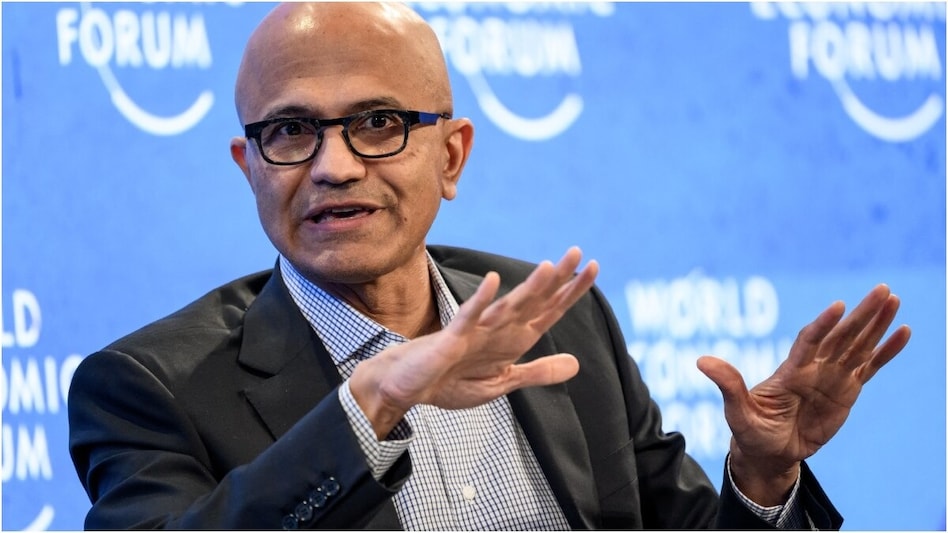
Davos 2026: AI skills must become the new pathway to jobs and mobility, says Satya Nadella
During his address at the World Economic Forum in Davos, Microsoft CEO Satya Nadella emphasized the importance of artificial intelligence as a catalyst for economic advancement. He called on governments and businesses to prioritize extensive skills training and to fundamentally rethink workplace dynamics. In a dialogue with Laurence Fink, Chairman and CEO of BlackRock, Nadella articulated that AI represents more than just a technological trend; it signifies a transformative shift in productivity, career development, and organizational frameworks across various sectors. "Individuals should be able to say, 'I learned this AI skill, and now I can enhance the value I bring to the economy,'" he remarked. Nadella drew comparisons between the current AI adoption and the early days of personal computing, noting that the necessity for professionals to master software like Excel and Word was essential for maintaining their employability. He asserted that the forthcoming phase of economic progress hinges on the widespread training of individuals in AI technologies. He highlighted that the success of AI integration will rest not only on technological advancements but also on the collaborative efforts of governments and corporations to provide access and training opportunities. "It’s crucial for both the private and public sectors to ensure that AI skills are disseminated widely," he stated, raising the critical question of how many individuals will be proficient in these tools. Moreover, Nadella pointed out that AI will require a fundamental rethinking of organizational operations. He described a shift in the traditional flow of information, stating, "AI fundamentally changes how information circulates within an organization. This necessitates a redesign of current work structures, as they may no longer be relevant. Leaders must adapt workflows to align with these technological changes." His insights come at a time when companies worldwide are rapidly integrating AI into their operations, spanning software development, customer service, finance, manufacturing, and healthcare. Concurrently, governments are implementing national AI strategies aimed at preparing the workforce for this technological evolution. Microsoft continues to lead in AI infrastructure and deployment, driven by its partnerships and significant investments in cloud computing and enterprise AI solutions. At Davos, Nadella framed AI as a pivotal economic revolution, one that will favor those who embrace change early and invest in comprehensive skills training.
Market Turbulence: Four Key Factors Impacting Stocks This Week
This past week has been challenging for the stock market, driven by several significant forces that have created turbule...
CNBC | Jul 25, 2026, 20:05
Revolutionizing Startup Living: Inside London's Unique Lift House
In East London, a group of six young entrepreneurs is redefining the concept of collaborative living for tech founders. ...
TechCrunch | Jul 26, 2026, 17:10
The AI Arms Race: U.S. Concerns Ignite Over Chinese Innovations
The recent unveiling of Kimi, an AI model from the Chinese company Moonshot AI, has sparked renewed discussions about Am...
TechCrunch | Jul 26, 2026, 20:05
Uber's Former CEO Makes Waves with New Ventures Amidst Tesla's Earnings Update
In the ever-evolving landscape of transportation, recent developments have come to the forefront, particularly surroundi...
TechCrunch | Jul 26, 2026, 16:25
The Elusive Phineas Fisher: The Hacktivist Who Took Down Spyware Giants
In the realm of cybersecurity, few figures are as intriguing as Phineas Fisher, a hacker who has evaded capture for near...
TechCrunch | Jul 25, 2026, 21:00