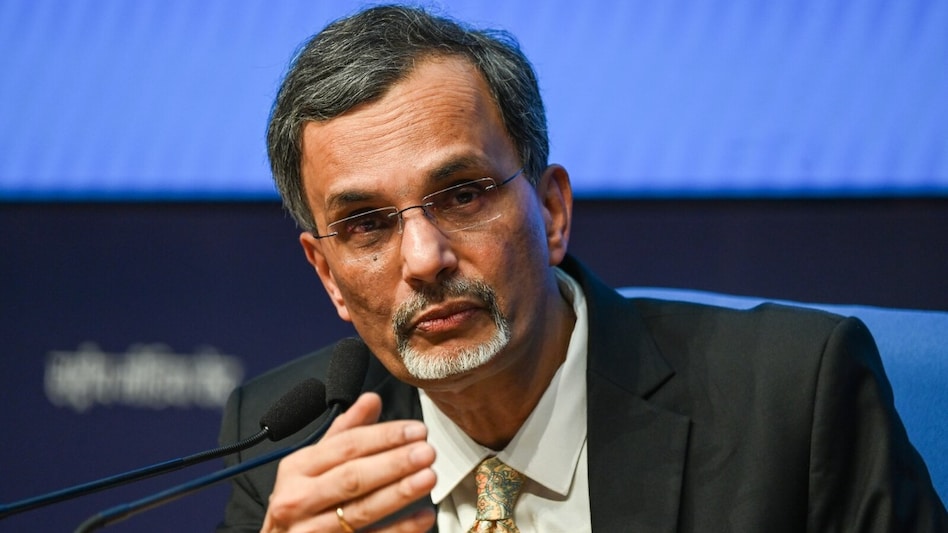
Teach judgement over technique to survive AI wave: CEA Nageswaran urges B-schools
The rise of artificial intelligence (AI) presents a significant challenge to management education, potentially reshaping the landscape for future professionals, according to Chief Economic Adviser V Anantha Nageswaran. Speaking at the 16th Indian Management Conclave in Noida, he emphasized that AI is set to eliminate many entry-level positions that have traditionally served as essential training grounds for young professionals. Nageswaran pointed out that with automation taking over routine tasks, the foundational apprenticeship model in management education is under threat. "AI now effectively handles the junior-level work, removing the bottom rungs of the career ladder," he stated. He raised concerns about the future of learning judgment in the workplace, questioning, "If AI removes the apprenticeship, where will the next generation of judgment come from?" He warned that simply adding a technology elective to business school programs will not suffice. Instead, educational institutions must focus on cultivating critical thinking, discernment, and problem-framing skills. Nageswaran remarked, "The manager's essential tool is a clear and patient mind, which is increasingly challenged before students even arrive on campus." He also noted the cognitive distractions posed by social media as an additional hurdle for young minds. Nageswaran stressed the importance of prioritizing judgment over technical skills, stating, "If AI conducts the analysis, the rare skill becomes knowing which questions to ask and trusting the answers provided." His comments reflect a broader view on how AI is transforming the global job market. Unlike past automation phases that mainly affected manual labor, AI is now impacting cognitive and skill-based roles across various sectors, including IT services and research. He highlighted a shift away from traditional software engineering and standard MBA programs towards trades, caregiving, and other human-centric professions that require physical presence and accountability. Despite the challenges posed by AI, Nageswaran encouraged educators and leaders to view it as a tool for enhancement rather than a mere threat. He pointed out that India is home to nearly half of the world's Global Capability Centers (GCCs), indicating that effectively managed institutions can harness automation to elevate the value of human labor. "A nation that perceives powerful technology as an unavoidable fate will be shaped by it, whereas a nation that treats AI as a tool will be able to shape it," Nageswaran concluded. He urged that the objective should not be to force people to work like machines, but rather to leverage machines to free individuals for tasks that require reasoning, decision-making, and responsibility.
Investing in the Future: Solar and Battery Solutions for AI Data Centers
The challenge of powering AI data centers has emerged as a pivotal issue in the current technological landscape. Over th...
TechCrunch | Nov 24, 2026, 16:25
Supertake Secures $20 Million to Revolutionize AI-Driven Investment Portfolios
Supertake, an innovative AI investing startup, is on a mission to transform how individuals engage with the stock market...
TechCrunch | Nov 23, 2026, 22:10
Amazon's $7.5 Billion Acquisition of Decart: A Strategic Move in the AI Chip Landscape
In a significant development for the tech industry, Amazon has announced its acquisition of Decart, a startup specializi...
TechCrunch | Nov 24, 2026, 15:55
Mathematicians React to Controversial Joke Over Lengthy Proof of Riemann Hypothesis
Tensions are rising in the mathematical community following a controversial comment made by Levent Alpöge, a researcher ...
Business Insider | Nov 24, 2026, 17:30Tidal Takes Bold Step Against AI Music Flood, Set to Remove Millions of Tracks
In a decisive move to combat the overwhelming influx of AI-generated music, Tidal announced on Tuesday its plans to ban ...
TechCrunch | Nov 24, 2026, 17:10