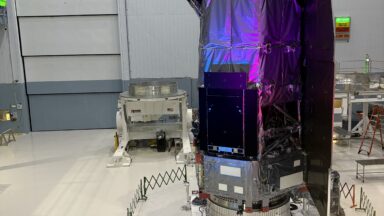
Eight months early and under budget, the Roman Telescope is ready to launch
In an exciting development for astronomical research, NASA has unveiled the fully assembled Nancy Grace Roman Space Telescope, which is now primed for its upcoming launch in September. This groundbreaking observatory, named in honor of a pivotal figure in the Hubble Space Telescope's planning, boasts a unique wide-field view and an impressive imaging system that enables it to transmit a staggering 1.4 terabytes of data to Earth daily. The Roman Space Telescope's journey began with fascinating intersections of NASA's planning and surplus spy satellite technology. While our atmosphere absorbs a significant portion of infrared wavelengths—essential for studying many cosmic phenomena—this poses challenges for ground-based infrared astronomy. Many crucial events, such as the formation of early galaxies and the analysis of exoplanet atmospheres, can only be observed through infrared wavelengths. Previous missions like the Spitzer Space Telescope have focused on high-resolution imaging of specific sky sections, but there was a clear demand for a telescope that could capture extensive areas of the sky simultaneously. The Roman Telescope aims to fulfill this need, offering insights into the large-scale structure of the early Universe and significantly expanding the catalog of asteroids near Earth. Initially conceptualized as WFIRST, the Wide Field Infrared Survey Telescope, NASA's vision for this project evolved further when the National Reconnaissance Office offered two surplus spy satellites, which proved to be compatible with the WFIRST specifications. NASA's Mark Melton noted that the original design called for a 1.5-meter telescope, but the NRO's hardware was nearly double that size, necessitating substantial upgrades. Consequently, the Roman Telescope now stands tall, surpassing the height of a two-story building, and promises to deliver enhanced resolution and more advanced imaging capabilities.
Former OpenAI Engineer Granted Release on Bond Amid Espionage Allegations
Abdulrahman Alfozan, the ex-OpenAI engineer who was terminated and subsequently arrested last month, is poised to be rel...
Business Insider | Nov 24, 2026, 20:40Tidal Takes Bold Step Against AI Music Flood, Set to Remove Millions of Tracks
In a decisive move to combat the overwhelming influx of AI-generated music, Tidal announced on Tuesday its plans to ban ...
TechCrunch | Nov 24, 2026, 17:10
Cybersecurity Alert: Iranian Hackers Target Shipping Vessels in Surge of Attacks
U.S. authorities are investigating a series of cyberattacks on shipping vessels, with suspicions pointing toward Iranian...
TechCrunch | Nov 24, 2026, 21:15
Anthropic's Stock Plummets, Raising Concerns for the AI Sector
Shares of Anthropic have dipped below their initial public offering (IPO) price of $83, reaching a low of $76 by midday ...
TechCrunch | Nov 24, 2026, 18:45
Uber and Nuro Kick Off Driverless Trials for Lucid Robotaxis Ahead of 2027 Launch
Uber and Nuro have officially launched their driverless testing phase for the Lucid Gravity SUVs on the streets of the S...
TechCrunch | Nov 24, 2026, 17:15