You want your Moon landings in HDTV? So does NASA. Here’s how it’s happening.
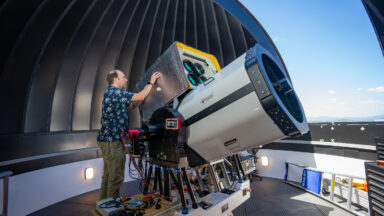
During the Artemis II mission, a crew of four astronauts transmitted low-definition video back to Earth, offering a glimpse of both the interior of their spacecraft and the lunar landscape. While this footage was exciting, it fell short of the stunning clarity expected in today's world of high-definition television. This limitation arose because the Orion spacecraft primarily communicated with Earth using radio waves, a method that harkens back to the Apollo missions over fifty years ago. However, the mission featured a groundbreaking component that set it apart from its predecessors. Astronauts aboard Orion occasionally sent back significantly higher-resolution images, including breathtaking pictures of the Moon's far side and a solar eclipse witnessed from lunar orbit. This leap in transmission quality was facilitated by cutting-edge optical laser communications technology, which included contributions from commercial partners. In stark contrast to the Apollo missions that transmitted data at a mere 50KB per second, Orion's standard communication via S-band achieved rates between 3MB and 5MB per second. But when the spacecraft activated its optical communications terminal, it could send data back to Earth at an astonishing 260 Mbps. This remarkable speed meant that a full HD movie could have been transmitted in just seconds. Despite these impressive capabilities, the full potential of the optical communications system was not realized during this mission. The technology was still in the experimental phase, and only three ground stations—two in the United States and one in Australia—were equipped to receive and process the laser signals. As NASA explores the possibilities of faster, more efficient data transmission from space, the Artemis II mission marks a significant step toward a future where high-definition imagery from lunar and other extraterrestrial missions could become the norm.
OpenAI Shifts Focus to Family-Centric AI Experiences
In a significant pivot, OpenAI is expanding its target audience from individual users to families as it seeks to enhance...
TechCrunch | Jul 11, 2026, 14:30
Revolutionizing Productivity: Even Realities Unveils G2 Smart Glasses Without Cameras
In recent years, numerous tech leaders have suggested that smart glasses could become the next significant interface for...
TechCrunch | Jul 11, 2026, 17:55
From Code to Concrete: A Developer's Leap into Blue-Collar Work
Brian Gordon, once a passionate coder, found himself confronting an unexpected career shift after his job as a frontend ...
Business Insider | Jul 11, 2026, 09:15Wall Street's Roller Coaster: AI Stocks Surge While Oil Prices Create Unease
Last week, Wall Street experienced a tumultuous trading environment, marked by a notable rise in artificial intelligence...
CNBC | Jul 11, 2026, 16:25
Apple Takes Legal Action Against OpenAI Over Alleged Trade Secret Infringement
Apple has initiated a lawsuit against OpenAI, claiming that the AI company unlawfully acquired confidential information ...
Business Today | Jul 11, 2026, 06:35