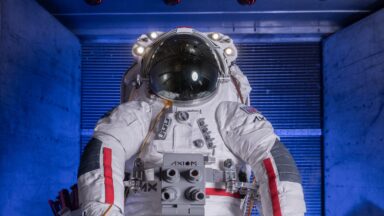
What’s the deal with spacesuits for the Moon? Will they be ready in time?
Following the successful Artemis II mission earlier this month, attention has shifted to NASA's next steps for returning humans to the Moon. A major concern is the readiness of lunar landers, crucial machines designed to transport astronauts to the Moon's surface and back to orbit. Reports indicate that both SpaceX and Blue Origin still have considerable development and testing ahead before they can present a working prototype. An equally pressing issue has emerged regarding the development of spacesuits, which are essential for astronauts to step out of their landers and explore the Moon. While much less is known about the progress in this area, a recent report from NASA’s Inspector General has provided some insights. As the agency aims for an ambitious timeline to land humans on the Moon by 2028, the report highlights key aspects of the spacesuit procurement process. The report details NASA's long and complicated journey to acquire next-generation lunar spacesuits. The agency, having struggled internally for decades with spacesuit development, opted for a different approach in 2022. This shift led to the awarding of two Exploration Extravehicular Activity Services (xEVAS) contracts—valued at up to $3.1 billion—to Axiom Space and Collins Aerospace, with the intention of streamlining the procurement process. Axiom, a newer company with no prior experience in spacesuit manufacturing, partnered with Collins, a more established provider. However, just two years into the contracts, Collins Aerospace withdrew from the competition, citing difficulties in managing the contract and profitability concerns. The Inspector General’s report notes that this unexpected exit has left NASA with only one spacesuit provider, Axiom. The implications of this situation are significant. If Axiom fails to meet its contractual obligations promptly and cost-effectively, NASA may have no choice but to continue using the existing, outdated Extravehicular Mobility Units (EMUs) throughout the International Space Station's operational life, potentially derailing lunar mission plans.
Current AI: Pioneering a Free and Inclusive Future for Global AI Access
In a rural corner of India, a farmer captures an image of a struggling plant, hoping to seek guidance online. However, h...
TechCrunch | Jul 19, 2026, 14:10
Kimi AI Sparks Controversy Amid Global Tensions
This week, the Chinese firm Moonshot AI unveiled an updated version of its Kimi model, reigniting discussions surroundin...
TechCrunch | Jul 18, 2026, 19:00
Dueling Interests: The Clash Over Robotaxi Regulations in D.C.
In the rapidly evolving landscape of transportation, the battle for robotaxi regulations is heating up, particularly as ...
TechCrunch | Jul 19, 2026, 16:20
The Evolution of Team Dynamics in the Age of AI
Silicon Valley is experiencing a significant transformation in team structures as the influence of artificial intelligen...
Business Insider | Jul 19, 2026, 10:05Nvidia's Jensen Huang Champions Japan's AI Future During Tokyo Summit
Jensen Huang, the CEO of Nvidia, recently concluded a two-day visit to Tokyo, engaging with Japan's leading industrial a...
TechCrunch | Jul 19, 2026, 21:35