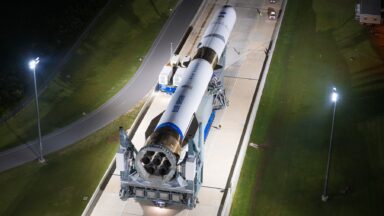
Here’s how orbital dynamics wizardry helped save NASA’s next Mars mission
CAPE CANAVERAL, Florida—Astrodynamics may not be magical, but the skills of trajectory analysts can sometimes seem extraordinary. Such expertise was pivotal in averting a significant delay, or even the cancellation, of NASA’s ESCAPADE mission after the rocket failed to be ready for its scheduled launch window last year. ESCAPADE, which stands for Escape and Plasma Acceleration and Dynamics Explorers, is made up of two identical spacecraft that are set to embark on their journey to the red planet this Sunday aboard Blue Origin’s impressive New Glenn rocket. Rob Lillis, the mission’s principal investigator from the University of California, Berkeley, explained, “ESCAPADE is pursuing a very unusual trajectory in getting to Mars.” Instead of following the conventional Hohmann transfer windows that occur every 25 or 26 months, the mission has adopted a more flexible design. It will first enter a loiter orbit around Earth, waiting for the optimal alignment of Earth and Mars in November next year. Originally, ESCAPADE was meant to take a direct route from Earth to Mars, a journey typically spanning six to nine months. However, due to the current positioning of the planets, it will now launch when Mars is over 220 million miles away on the opposite side of the Solar System. The last opportunity to launch to Mars was last year, while the next window won’t open until late 2026, making the current misalignment a challenge for the mission. Fortunately for NASA, the New Glenn rocket is more than capable of handling this mission. The two-stage rocket can transport substantial payloads to Mars, but NASA only requires it to deliver about one ton, which includes the two science probes intended to explore the interaction between Mars’ upper atmosphere and the solar wind. Moreover, NASA has struck a favorable deal with Blue Origin, paying around $20 million for the launch—significantly less than the cost of a dedicated launch on alternate rockets capable of supporting the ESCAPADE mission. In return, NASA is accepting a higher-than-normal risk of launch failure, as this flight marks just the second journey for the towering 321-foot (98-meter) New Glenn rocket, which has yet to receive certification from NASA or the US Space Force.
Gritt Unveils $34 Million Initiative to Revolutionize Solar Panel Installation with AI-Driven Robotics
In a significant stride for solar energy deployment, Gritt has emerged from stealth mode, unveiling its ambitious plans ...
TechCrunch | Jul 21, 2026, 10:15
Anthropic Secures Unprecedented $1.5 Billion Settlement in Copyright Case
Anthropic has reached a monumental $1.5 billion settlement with a group of authors who accused the company of utilizing ...
Business Today | Jul 21, 2026, 13:10
South Korea's Stock Market: The New Pulse of Global AI Investments
The stock market in South Korea is rapidly emerging as a critical indicator for the global AI industry, with its pronoun...
Business Insider | Jul 21, 2026, 08:25Kimi K3 Ignites Debate on China's AI Landscape Amidst Global Competition
The recent unveiling of Moonshot AI's Kimi K3 model has set the Chinese internet abuzz with conversations and comparison...
Business Insider | Jul 21, 2026, 09:30China Considers New Export Controls on AI Technologies and Semiconductors
In a significant move reflecting rising global tensions over advanced technologies, China is contemplating stricter expo...
Business Today | Jul 21, 2026, 10:55