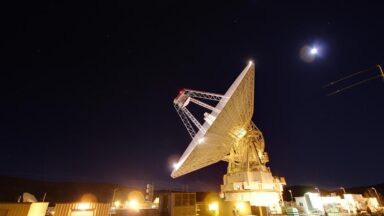
After nearly breaking, NASA’s Deep Space Network “worked well” on Artemis II
NASA faced significant challenges with its Deep Space Network (DSN) during the Artemis I mission nearly four years ago. The global network of deep space communication antennas struggled to manage the demands of 40 robotic science missions while simultaneously accommodating the heightened requirements of the Orion spacecraft as it orbited the Moon. This overwhelming demand in late 2022 led to reduced or delayed data transmissions from prominent science missions, including the James Webb Space Telescope and various Mars rovers, as the Artemis I mission took precedence over NASA's communication resources. As Artemis II launched on April 1, NASA once again relied on the DSN to maintain a vital connection between Mission Control and the Orion capsule, which was traveling over 250,000 miles from Earth. With a crew of four aboard, the data requirements for Artemis II were even more demanding than those of its predecessor, Artemis I. However, the duration of the Artemis II mission, lasting just over nine days compared to Artemis I’s 25-day journey, helped ease the strain on communication channels. Furthermore, Artemis I had deployed ten small CubeSats into deep space, each requiring tracking and telecom support from the DSN. In contrast, Artemis II launched with fewer CubeSats, further reducing the communication load. “From our experiences with Artemis I, we implemented new processes to enhance coordination and scheduling across all missions, not just for the Orion vehicle,” noted Greg Heckler, deputy program manager for capability development in NASA’s Space Communications and Navigation Program. “I believe these changes proved effective during Artemis II.”
Market Turbulence: Four Key Factors Impacting Stocks This Week
This past week has been challenging for the stock market, driven by several significant forces that have created turbule...
CNBC | Jul 25, 2026, 20:05
Nvidia Strikes Major Deal with SK Hynix to Secure AI Memory Supply
Nvidia has successfully forged a significant partnership with South Korea's SK Hynix to secure memory supplies essential...
CNBC | Jul 25, 2026, 05:15
SpaceX Successfully Tests Starship Rocket, Launching New Era of Space Exploration
On Friday evening, SpaceX executed a significant milestone by launching its colossal Starship rocket from its facility i...
CNBC | Jul 25, 2026, 24:10
Revolutionizing Office Automation: Prentis Aims to Secure $100 Million in Funding
Prentis, a newly established AI research lab, is making waves in the tech industry as it prepares to raise $100 million ...
TechCrunch | Jul 25, 2026, 24:00
Vision Breakthrough: US Startup Launches Groundbreaking Retina Chip in Europe
Science Corp is poised to introduce a revolutionary retina chip in Europe, designed to restore partial vision for indivi...
Business Today | Jul 25, 2026, 01:00