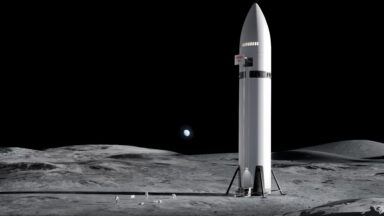
NASA has shuffled its Artemis rockets. But what of the lunar landers?
In a recent announcement, NASA Administrator Jared Isaacman revealed significant changes to the Artemis Program aimed at enhancing the United States' return to the Moon. The focus of these alterations is primarily on increasing the launch frequency of NASA's Space Launch System (SLS) rocket and placing greater importance on activities on the lunar surface. Following this announcement, the U.S. Senate expressed broad support for the revamped plans. However, these developments overlook a vital component of the Artemis initiative: a reliable lunar lander capable of transporting astronauts from lunar orbit to the surface and back to the Orion spacecraft. NASA has partnered with SpaceX and Blue Origin to create these landers, named Starship and Blue Moon MK2, respectively. As part of Isaacman’s strategy, the Artemis III mission is set to test one or both of these landers in low Earth orbit before they are tasked with carrying humans to the Moon later this decade. According to Isaacman, Artemis III is scheduled for launch next year, with the possibility of one or two lunar landings by 2028. However, achieving even a single landing before the end of 2028 appears ambitious, according to many in the space community. For this timeline to be feasible, both SpaceX and Blue Origin must accelerate their development efforts significantly. Recognizing the urgency, Isaacman has prioritized meetings with engineers from both companies to discuss strategies for speeding up the Artemis schedule. After a meeting held on January 13, Isaacman assured that NASA would work diligently to streamline the Human Landing System’s development. He stated, 'We will challenge every requirement, clear every obstacle, delete every blocker, and empower the team to deliver… all while ensuring we have time to spare.' This statement indicates a commitment to making the collaboration process with SpaceX and Blue Origin more efficient and less obstructive.
The Rise of AI Distillation: A Controversial Technique Sparks Debate in Tech and Government
In recent discussions, a once-obscure topic in artificial intelligence has surged to the forefront of debates among tech...
CNBC | Jul 25, 2026, 12:15
Reclaiming Control: Librarians Host Workshops to Help People Navigate AI Tools
In a lively library setting in South Philadelphia, Charlie Bailey, a local librarian, humorously noted, "Everybody’s on ...
TechCrunch | Jul 25, 2026, 16:20
Unleashing the Power of AI: The 5 Smartphones Redefining Mobile Photography
Artificial Intelligence (AI) is transforming our daily experiences, permeating various aspects of technology, including ...
Business Today | Jul 26, 2026, 07:05
Nvidia Strikes Major Deal with SK Hynix to Secure AI Memory Supply
Nvidia has successfully forged a significant partnership with South Korea's SK Hynix to secure memory supplies essential...
CNBC | Jul 25, 2026, 05:15
The Boring Company Eyes $4 Billion Funding Boost Amid Expanding Tunnel Ventures
Elon Musk's tunneling enterprise, The Boring Company, is reportedly negotiating a substantial funding round of $4 billio...
TechCrunch | Jul 25, 2026, 19:50