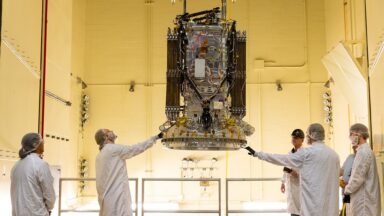
A bold satellite rescue mission came together in record time, but will it work?
In a remarkable feat of innovation and urgency, NASA has embarked on an unprecedented mission to rescue the Swift satellite, a critical asset in the field of astronomy. Just ten months ago, the space agency posed a challenging question to three companies: could they develop and launch a satellite capable of saving Swift, which is at risk of crashing back to Earth? Katalyst Space Technologies, a startup established in 2020, emerged as the frontrunner with a compelling proposal. "Their response was both technically sound and programmatically feasible, and that made our decision easy," remarked Shawn Domagal-Goldman, director of NASA’s astrophysics division. In September, NASA awarded Katalyst a $30 million contract to design, test, and launch a small satellite that will capture Swift using three robotic arms. The mission’s objective is to raise Swift’s orbit back to a safe altitude, enabling it to continue its valuable scientific work. However, this is no small task. Swift is currently in low-Earth orbit, where the atmosphere’s outer layers still affect its trajectory. Launched in November 2004, Swift has been instrumental in detecting gamma-ray bursts, some of the universe's most powerful explosions. Despite its age, it remains vital for astrophysicists, providing multi-wavelength data essential for subsequent observations. Yet, Swift faces a significant challenge: it lacks thrusters to maintain its orbit, leading to a gradual decline in altitude due to aerodynamic drag. Initially orbiting at approximately 363 miles (585 km) above Earth, Swift's altitude has now dropped to about 225 miles (363 km). As it descends further into denser atmospheric layers, the rate of decay will accelerate, ultimately risking the satellite's destruction during reentry. The clock is ticking, and the success of this mission could redefine the boundaries of satellite servicing and preservation in space exploration.
Crisis Averted: Power Line Failure Highlights Urgent Need for Data Center Resilience
A power line failure near Washington, DC, recently showcased a significant challenge faced by the electrical grid due to...
TechCrunch | Jul 25, 2026, 13:50
Unlocking the Secrets of Quantum Gravity: Can AI Help Physics Make a Leap?
The realm of scientific research is undergoing a profound transformation, fueled by the rapid advancements in artificial...
Business Today | Jul 25, 2026, 24:30
Reclaiming Control: Librarians Host Workshops to Help People Navigate AI Tools
In a lively library setting in South Philadelphia, Charlie Bailey, a local librarian, humorously noted, "Everybody’s on ...
TechCrunch | Jul 25, 2026, 16:20
Nvidia Strikes Major Deal with SK Hynix to Secure AI Memory Supply
Nvidia has successfully forged a significant partnership with South Korea's SK Hynix to secure memory supplies essential...
CNBC | Jul 25, 2026, 05:15
Vietnam's Controversial Social Media Proposal: A New Approach for Youth Engagement
Vietnam is contemplating a distinctive approach to youth social media regulations, diverging from the more common outrig...
TechCrunch | Jul 24, 2026, 21:25