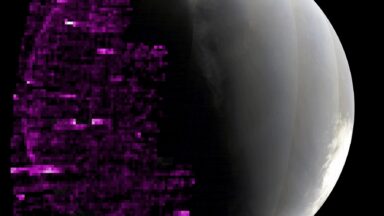
After 11 years at Mars, NASA’s MAVEN spacecraft went out with a whisper
NASA's MAVEN spacecraft, which had been successfully studying Mars for 11 years, experienced a troubling disappearance behind the planet on December 6 of last year. Initially expected to reestablish contact within an hour during a routine occultation, MAVEN failed to communicate as anticipated, prompting immediate contingency measures from ground teams. Engineers worked tirelessly to restore communication with the craft, which orbits Mars over 200 million miles away from Earth. Despite their best efforts to detect faint signals and send commands, they were met with silence. As time progressed without any signs of life from MAVEN, hopes dwindled, leading NASA to announce on Wednesday that they would cease efforts to locate the spacecraft. "NASA has ceased efforts to search for the MAVEN spacecraft and are beginning activities to decommission the mission," stated Mike Moreau, the project manager for MAVEN at NASA’s Goddard Space Flight Center in Maryland. MAVEN had launched from Earth in 2013 and reached Mars in 2014, aiming to explore the interactions between the Martian atmosphere and solar wind—a mission it executed with remarkable success over its operational period. The abrupt loss of MAVEN was unexpected, especially since many of NASA's planetary missions often last for decades. Investigators now face the daunting task of piecing together the events leading to the spacecraft's silence. They are currently analyzing the data transmitted just before the signal was lost and have managed to recover fragments of telemetry and Doppler shift data that were recorded after MAVEN passed behind Mars. "As part of this investigation, the team members at the Jet Propulsion Laboratory were successful in recovering some fragments of telemetry and Doppler shift data from the spacecraft," Moreau noted. These signals, although faint, were captured during a separate scientific campaign aimed at studying the density and dynamics of the Martian upper atmosphere, which can interfere with radio communications. The findings may provide insights, but the exact cause of MAVEN's failure remains elusive.
The Rise of AI Distillation: A Controversial Technique Sparks Debate in Tech and Government
In recent discussions, a once-obscure topic in artificial intelligence has surged to the forefront of debates among tech...
CNBC | Jul 25, 2026, 12:15
Warner Bros. Takes Legal Action Against Amazon Over Executive Poaching Allegations
Warner Bros. Discovery has initiated legal proceedings against Amazon, accusing the tech giant of unlawful interference ...
TechCrunch | Jul 25, 2026, 21:25
Market Turbulence: Four Key Factors Impacting Stocks This Week
This past week has been challenging for the stock market, driven by several significant forces that have created turbule...
CNBC | Jul 25, 2026, 20:05
The Shift in Human Cognition: Embracing AI as a Collaborative Tool
As technology continues to evolve, a notable shift is occurring in the relationship between humans and artificial intell...
Business Insider | Jul 25, 2026, 09:50OpenAI's Micro Keypad: A Novelty for Coders or Just a Confounding Gadget?
Last week, OpenAI made its debut in the hardware landscape with the launch of Micro, a stylish keypad designed to integr...
TechCrunch | Jul 25, 2026, 24:40