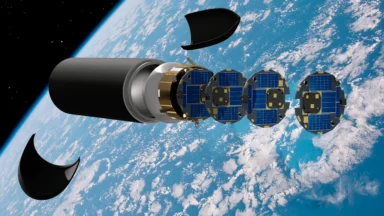
Here’s why NASA and the Space Force are interested in pizza-shaped satellites
In an exciting development, four small satellites were successfully launched into orbit early Thursday aboard a Rocket Lab Electron rocket from Virginia. This mission marks the beginning of a government-backed technology demonstration aimed at evaluating a novel spacecraft design. The satellites, encased in a cylindrical dispenser atop the 59-foot (18-meter) Electron rocket, lifted off from NASA's Wallops Flight Facility at 12:03 AM EST (05:03 UTC). Just over an hour later, the rocket's upper stage deployed the satellites one by one from an altitude of approximately 340 miles (550 kilometers). This launch initiates a "proof of concept" mission for testing a new satellite design known as DiskSats. Developed by the Aerospace Corporation, a nonprofit research and development organization, this project is co-financed by both NASA and the US Space Force, who funded the DiskSat's development and launch, respectively. According to the Aerospace Corporation, the DiskSat is a lightweight, compact satellite shaped like a flat disc, optimized for future rideshare launches. Each DiskSat measures 39 inches (1 meter) in diameter—roughly twice the size of a New York-style pizza—and is just 1 inch (2.5 centimeters) thick. Constructed from composite carbon fiber, these satellites are equipped with solar cells, control avionics, reaction wheels, and an electric thruster for altitude adjustments. Darren Rowen, the chief engineer of the project, expressed satisfaction with the launch, stating, "The launch went perfectly, and the DiskSat dispenser worked exactly as designed. We’re pleased to have established contact with all four of the DiskSats, and we’re looking forward to the rest of the demonstration mission." Since its inception in 1960, the Aerospace Corporation has played a pivotal role in supporting the US military and NASA. The concept of the DiskSat emerged from a survey of the government's evolving needs in space exploration, showcasing the innovative spirit of the organization.
Databricks Achieves $188 Billion Valuation Amid AI Revolution
Databricks has announced a significant new funding round that values the company at an impressive $188 billion, followin...
TechCrunch | Jul 17, 2026, 22:15
Meet the Innovators: 18 Startups Revolutionizing Dating and Social Networking
A new wave of startups is emerging, poised to transform the landscape of dating and social networking. These innovative ...
Business Insider | Jul 18, 2026, 15:50Reimagining Data Centers: Building Community Connections Through Innovative Design
In the heart of a California desert oasis, a groundbreaking initiative is changing the perception of data centers. A new...
Business Insider | Jul 18, 2026, 08:25Nvidia CEO's Iconic Leather Jacket Fetches Nearly $1 Million at Auction
Jensen Huang, the CEO of Nvidia, is known for his distinctive style, often sporting a leather jacket that has become his...
CNBC | Jul 17, 2026, 23:25
Breaking Barriers: EV Charging Experience Transformed on a 600-Mile Journey
Concerns over electric vehicle (EV) charging infrastructure have historically deterred many potential buyers. According ...
TechCrunch | Jul 18, 2026, 15:20