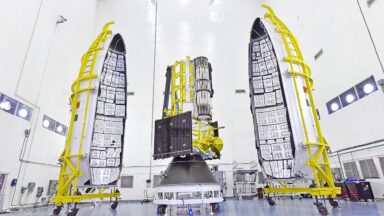
India safely launches a $1.5 billion satellite for NASA
In a significant milestone for space exploration, NASA's leadership made a special trip to India this week to witness the launch of the most expensive Earth-observation satellite in history. The synthetic aperture radar imaging satellite, part of a collaborative effort between NASA and the Indian Space Research Organisation (ISRO), successfully entered orbit on Wednesday, aboard India's Geosynchronous Satellite Launch Vehicle, a medium-lift rocket. Dubbed NISAR (NASA-ISRO Synthetic Aperture Radar), this cutting-edge mission was positioned in its designated orbit 464 miles (747 km) above the Earth. From this Sun-synchronous orbit, NISAR is set to gather crucial data about the Earth's land and ice surfaces, capturing vital information twice every 12 days, including from rarely explored regions in the Southern Hemisphere. The satellite is equipped with two primary instruments that enable it to collect data even in adverse conditions like cloud cover and nighttime. NASA's L-band synthetic aperture radar is adept at assessing soil moisture, forest conditions, and the dynamics of land and ice. Meanwhile, India has contributed an S-band radar, which specializes in monitoring agricultural shifts, grasslands, and urban infrastructure. NISAR stands out as one of the first missions to integrate two distinct radar bands on a single platform, enhancing our understanding of the planet's surface changes in real-time. Following its launch, the spacecraft will enter a three-month commissioning period, during which it will deploy a massive antenna reflector measuring 39 feet (12 meters) in diameter. This reflector will facilitate the transmission and reception of microwaves from both radar systems, allowing for detailed measurements of the Earth's surface. The mission is remarkable not only for its substantial financial investment—typically, Earth observation projects are less costly due to their lack of deep space resilience—but also for the unprecedented collaboration between NASA and ISRO. This partnership represents the most complex and expensive joint effort between the two agencies to date, potentially paving the way for future cooperative ventures in space exploration, including the Artemis program and beyond.
Final Call for Australian Startups: Seize Your Chance at Stripe x Startup Battlefield
Time is running out for aspiring Australian entrepreneurs! In just 48 hours, the opportunity to showcase your startup at...
TechCrunch | Jul 17, 2026, 23:25
Databricks Achieves $188 Billion Valuation Amid AI Revolution
Databricks has announced a significant new funding round that values the company at an impressive $188 billion, followin...
TechCrunch | Jul 17, 2026, 22:15
San Francisco Demands Apple and Google Eliminate Controversial 'Nudify' Apps from Their Platforms
San Francisco officials have taken a strong stance against the proliferation of 'nudify' apps, which are designed to dig...
TechCrunch | Jul 17, 2026, 20:05
New Era of AI Regulation: White House Gains Control Over Model Access
The current administration is taking significant measures to enhance its authority over the deployment of advanced artif...
CNBC | Jul 17, 2026, 22:15
Reimagining Data Centers: Building Community Connections Through Innovative Design
In the heart of a California desert oasis, a groundbreaking initiative is changing the perception of data centers. A new...
Business Insider | Jul 18, 2026, 08:25