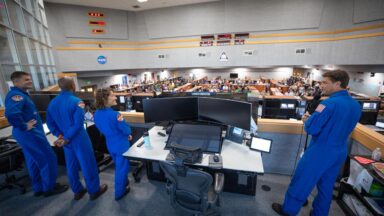
NASA targeting early February for Artemis II mission to the Moon
NASA is making significant strides in its plans to send humans beyond low-Earth orbit for the first time in over fifty years. During a recent news briefing at Johnson Space Center, officials announced that the Artemis II mission is targeting a launch window that begins on February 5, 2026. This mission marks a pivotal moment for NASA, as it aims to transport four astronauts—Reid Wiseman, Victor Glover, Christina Koch, and Jeremy Hansen—on a journey around the Moon and back. The ten-day expedition will be a historic milestone, representing the first time astronauts have ventured beyond low-Earth orbit since Apollo 17 in December 1972. The Space Launch System (SLS) rocket, designed for this monumental flight, has already been assembled and is deemed ready for launch. The Orion spacecraft is currently in its final stages of preparation and is expected to be placed atop the rocket by the end of this year. Charlie Blackwell-Thompson, the Artemis launch director, indicated that early next year, the fully assembled rocket and spacecraft will be transported to Kennedy Space Center for final preparations. At the launch pad, the SLS rocket and Orion will be integrated with ground support systems, followed by a crucial “wet dress rehearsal.” This critical test will involve fully fueling the rocket's first and second stages with liquid hydrogen and oxygen, and will take the countdown down to T-29 seconds before the rocket is de-tanked and readied for its launch. Considering the orbits of the Earth and Moon, there are specific launch windows each month lasting from four to eight days. The window for February 2026 opens on the fifth, and officials have indicated that it would involve an evening launch. After liftoff, the Orion spacecraft is set to separate from the SLS rocket’s upper stage approximately three hours into the flight. The astronauts will spend roughly 24 hours in orbit around Earth, during which they will conduct essential checkouts to verify that the spacecraft's life support systems, thrusters, and other critical equipment are functioning properly.
Ford Teams Up with Apple to Revolutionize Electric Vehicle Technology
Apple has unveiled a suite of developer tools designed to allow car manufacturers to integrate Apple Maps directly into ...
TechCrunch | Jul 23, 2026, 14:05
Google Cloud Sees Surge in Customer Spending as Growth Soars
In a recent revelation, Thomas Kurian, the CEO of Google Cloud, announced that the company’s current customers are spend...
CNBC | Jul 23, 2026, 15:05
Amazon and Microsoft Shift Strategies in Cloud Gaming to Capture Diverse Audiences
In a bid to reshape the landscape of cloud gaming, both Amazon and Microsoft have introduced innovative strategies aimed...
CNBC | Jul 23, 2026, 16:15
AI Startup Etched Surges to $10.3 Billion Valuation, Defying Doubters
Etched, an ambitious AI chip startup founded by three former Harvard students in 2022, has successfully secured $300 mil...
TechCrunch | Jul 23, 2026, 15:20
Elon Musk Embraces AI Risks for a Future of Abundance
In a thought-provoking interview with Zanny Minton Beddoes, the editor in chief of The Economist, Elon Musk shared his i...
Business Insider | Jul 23, 2026, 12:20