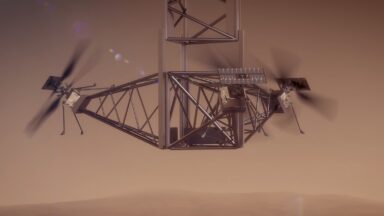
Engineers at NASA’s Jet Propulsion Lab make a breakthrough in rotor technology
Just over three years after the successful conclusion of NASA's Ingenuity helicopter mission on Mars, engineers at the Jet Propulsion Laboratory in California are making significant strides in developing next-generation rotorcraft. These new Martian helicopters are designed to carry heavier payloads and travel greater distances in the planet's thin atmosphere. Ingenuity made history as the first aircraft to operate on another planet, completing an impressive 72 flights and far exceeding its initial target of five flights within a 30-day period. This achievement, delivered to Mars by the Perseverance rover, provided groundbreaking insights into aerial exploration, demonstrating the potential for air travel to reach locations on Mars that are otherwise inaccessible to ground vehicles. Looking ahead, NASA has ambitious plans to send three additional helicopters to Mars as part of the upcoming SkyFall mission, which is anticipated to launch as early as late 2028. These helicopters will travel to the red planet aboard a nuclear-powered craft known as Space Reactor-1 (SR-1), part of a series of technology demonstration initiatives introduced by NASA Administrator Jared Isaacman earlier this year. While Ingenuity was compact—comparable in size to a tissue box and weighing only 4 pounds (1.8 kilograms)—the next generation of SkyFall helicopters will be larger and heavier. These new rotorcraft will utilize an innovative landing technique, descending onto the Martian surface after entering the atmosphere encased in a heat shield. This advancement necessitates significant design innovations. The engineering team at JPL, alongside private partner AeroVironment—who also played a key role in developing Ingenuity—has recently achieved a breakthrough in their laboratory tests. These tests focus on the new, larger rotor blades designed to navigate Mars' rarefied atmosphere, which is only 1 percent as dense as the air at sea level on Earth. Such advancements bring the SkyFall mission closer to reality, paving the way for exciting future explorations of Mars.
Tech Giants Unite to Advocate for Open AI Models Amid Regulatory Concerns
In a bold move reflecting their shared vision for the future of artificial intelligence, leading tech figures have come ...
Business Insider | Jul 24, 2026, 14:45Infosys Appoints Veteran Leader to Navigate the AI Landscape
Infosys has made a significant move by naming Ashiss Kumar Dash, a long-time company insider, as its next Chief Executiv...
Business Today | Jul 24, 2026, 15:25
Anthropic Unveils Claude Opus 5: A Game-Changer in Cost-Effective AI
Anthropic has officially launched its latest AI model, Claude Opus 5, which the company claims is its most efficient and...
CNBC | Jul 24, 2026, 17:20
Midjourney Expands Horizons with Acquisition of Co-Star Astrology App
In a significant move to diversify its offerings, Midjourney, the AI lab renowned for its innovative image and video gen...
TechCrunch | Jul 24, 2026, 15:25
Revolutionizing Interaction: ChatGPT Desktop App Introduces Voice Control
OpenAI has unveiled an exciting update for its ChatGPT desktop application, introducing a voice control feature that ena...
TechCrunch | Jul 24, 2026, 14:00