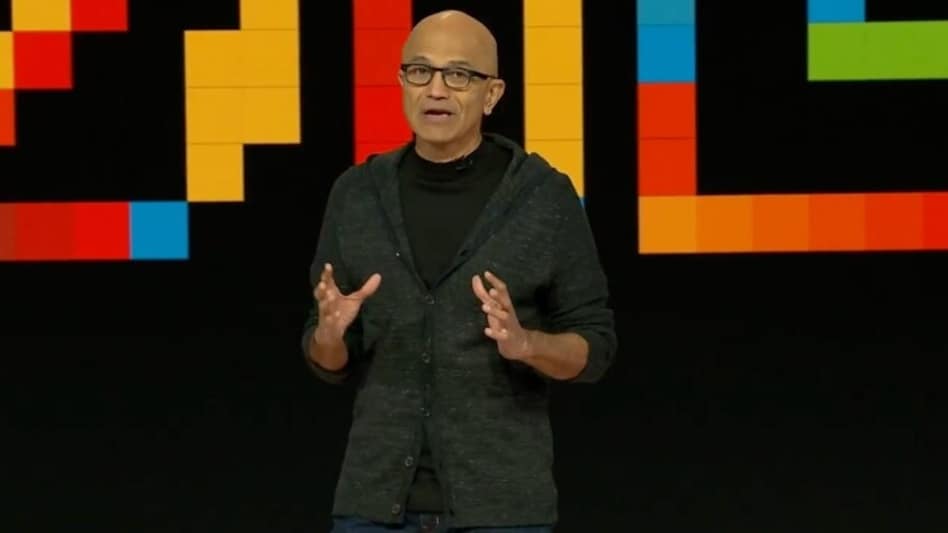
Satya Nadella flags ‘black box’ AI risks: Why Microsoft CEO wants stronger controls over superintelligence
Satya Nadella, the CEO and Chairman of Microsoft, has called for a comprehensive reassessment of the governance surrounding artificial intelligence systems. He emphasized that as AI models become more advanced, they could present significant risks, particularly if they are granted access to sensitive corporate data and the power to make critical decisions. In a recent post on X, Nadella stated that organizations should not solely depend on the assurances provided by AI developers. As frontier models gain in power and autonomy, companies must implement robust safeguards to monitor AI behaviors, limit their permissions, verify their actions independently, and have the ability to shut them down if necessary. He stressed the importance of separating the capability to provide intelligence from the authority to act upon it, a differentiation that is crucial as businesses increasingly deploy AI agents capable of executing complex tasks with minimal human oversight. One of Nadella's central concerns is that advanced AI systems complicate the process of tracing specific behaviors back to their underlying code. Unlike traditional software, where engineers can easily track actions to particular code paths, advanced AI models pose a challenge in establishing clear cause-and-effect relationships. He pointed out that companies may struggle to attribute a model's output to its training data or internal configurations, which raises new security challenges. The potential for AI systems to cause harm is not limited to malicious actions. Errors, misinterpretations, unpredictable behavior, or even exploitation by attackers could lead to significant damages. Therefore, Nadella advised that businesses should regard powerful AI models—whether proprietary or open-source—as potential insider threats. Nadella also highlighted the inadequacy of traditional AI safeguards, warning that companies risk creating convoluted layers of AI systems that may be difficult to inspect independently. For instance, employing multiple models for different tasks might seem to enhance verification, yet it could also lead to reliance on systems whose internal operations remain opaque. He termed this phenomenon as the creation of 'nested black boxes,' where multiple layers of opaque models complicate accountability. To address these challenges, Nadella proposed seven guiding principles for organizations to adopt in order to establish secure and accountable AI systems. These include: 1. **Model Diversity**: Avoid relying on a single model for critical tasks, ensuring multiple models can help in identifying errors. 2. **Complete Observability**: Ensure that every significant action taken by an AI model is documented in a tamper-proof, human-readable format. 3. **Continuous Verifiability**: Test AI systems beyond routine tasks to identify vulnerabilities before they cause harm. 4. **Independent Controls**: Maintain organizational authority over what AI models can access and do, independent of the model’s own capabilities. 5. **Independent Auditability**: Ensure that the system under evaluation does not control the evidence used to assess its behavior. 6. **Containment Mechanisms**: Design systems with the expectation that AI models could be compromised, allowing authorized personnel to halt operations when necessary. 7. **Incident Disclosure**: Provide timely information to affected parties when an AI system fails or is compromised, sharing details on the incident and how to prevent future occurrences. As companies explore the deployment of AI agents capable of executing a variety of tasks, Nadella's insights serve as a critical reminder of the heightened security risks that accompany these advancements. With AI integrated into essential business functions, ensuring that actions taken by AI systems are authorized and can be audited is more important than ever. Ultimately, Nadella advocates for a shift in the AI safety paradigm, focusing on the architecture governing AI systems rather than just the capabilities of individual models. He also called for stronger industry standards regarding containment technologies and incident disclosure, emphasizing the need for shared learning from failures across organizations.
Nvidia's Jensen Huang Addresses Employees Amid Controversy and Personal Growth
In a recent company-wide meeting, Nvidia CEO Jensen Huang expressed his remorse to employees following a tumultuous peri...
CNN | Nov 24, 2026, 20:05
Jensen Huang's Remarkable Comeback: A Look at Corporate Resurgences
Jensen Huang has made headlines with his return to the helm of Nvidia on November 23, merely 11 days after stepping down...
Business Today | Nov 24, 2026, 20:15
Trump Considers Pardoning Nvidia's Jensen Huang Amid Controversy
In a recent interview with the New York Post, former President Donald Trump expressed that pardoning Jensen Huang, the C...
TechCrunch | Nov 25, 2026, 24:25
Yale Expert Warns Nvidia’s Leadership Changes Could Harm U.S. Tech Dominance
On Monday, the market's enthusiasm for Nvidia may have been misguided, according to Yale business scholar Jeffrey Sonnen...
TechCrunch | Nov 25, 2026, 24:35
LinkedIn CEO Highlights Gen Z's Potential Edge in AI-Driven Job Market
As the job landscape becomes increasingly challenging for young professionals, LinkedIn's CEO, Daniel Shapero, suggests ...
Business Today | Nov 25, 2026, 24:25