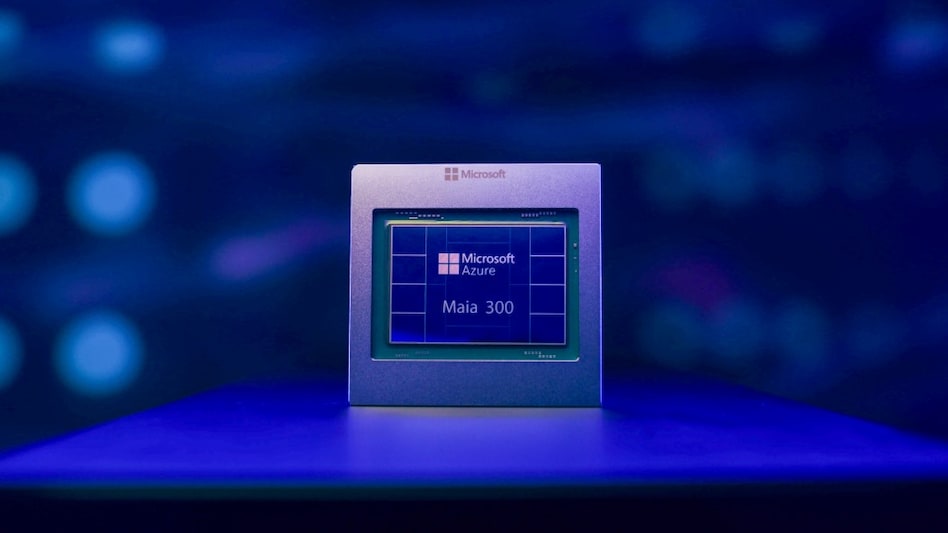
Microsoft challenges Nvidia dependence with new in-house Maia 300 AI chip; All details
On October 12, Microsoft introduced its third-generation AI accelerator, the Maia 300, aiming to lessen its reliance on Nvidia GPUs. This innovative chip is engineered to execute trained AI models, reinforcing Microsoft's commitment to enhancing AI capabilities across its ecosystem, particularly for cloud-based applications. The Maia 300 chip is specifically optimized for inference, the process whereby AI models generate text, code, or respond to various prompts. By creating this in-house solution, Microsoft seeks to strengthen its control over computing infrastructure, moving away from dependency on external GPU suppliers like Nvidia. Microsoft CEO Satya Nadella announced the Maia 300 in an X post, highlighting that the chip can produce 40% more AI tokens per watt compared to leading GPU alternatives. “Next calendar year, we will expand our Maia family to multi-gigawatt deployments, making it the cornerstone of our inference systems for our products and services,” Nadella remarked. He also noted that the deployment of Maia AI chips is already underway in data centers across the United States, Europe, and Australia. The Maia 300 is designed to handle substantial data loads efficiently, balancing compute, memory bandwidth, networking, and power efficiency. It features eight HBM4 stacks that deliver peak bandwidth of 18 TB/s, supporting intensive AI tasks. Employing a multi-chiplet architecture, the Maia 300 separates computing, memory control, and input/output functionalities. Its chiplets are produced using TSMC's N2P process, emphasizing improved efficiency and scalability. This architecture facilitates effective communication and workload sharing among multiple AI accelerators within data centers. Microsoft's Maia 300 systems can house 96 accelerators in a 167-kilowatt power envelope, offering 27.6 TB of combined HBM capacity and an impressive 1.7 PB/s of aggregate HBM bandwidth. This configuration aims to enhance the ability to run multiple AI workloads simultaneously and boost computing capacity per rack. While Microsoft transitions to the Maia infrastructure, it will retain the use of Nvidia and AMD chips for certain resources. Nonetheless, the Maia 300 chip has the potential to rival third-party GPU suppliers in the market.
Saudi Engineer Faces Legal Battle Over Alleged Espionage Using AI Tech
A Saudi engineer employed by OpenAI, Abdulrahman Alfozan, is at the center of a legal dispute as prosecutors allege he u...
Business Insider | Nov 23, 2026, 23:50Threads Expands to iPad with New Cashtag Feature to Rival X
Meta's Threads app has officially launched a dedicated version for iPad, marking a significant milestone in its developm...
TechCrunch | Nov 24, 2026, 18:00
Investing in the Future: Solar and Battery Solutions for AI Data Centers
The challenge of powering AI data centers has emerged as a pivotal issue in the current technological landscape. Over th...
TechCrunch | Nov 24, 2026, 16:25
Tidal Takes Bold Step Against AI Music Flood, Set to Remove Millions of Tracks
In a decisive move to combat the overwhelming influx of AI-generated music, Tidal announced on Tuesday its plans to ban ...
TechCrunch | Nov 24, 2026, 17:10
Amazon's $7.5 Billion Acquisition of Decart: A Strategic Move in the AI Chip Landscape
In a significant development for the tech industry, Amazon has announced its acquisition of Decart, a startup specializi...
TechCrunch | Nov 24, 2026, 15:55