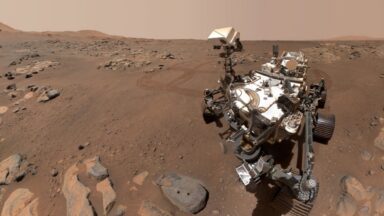
Has Perseverance found a biosignature on Mars?
A year ago, NASA's Perseverance rover captured attention with its discovery of a uniquely shaped arrow-like rock on Mars, which hinted at chemical signatures potentially linked to ancient microbial activity. Although this finding did not provide conclusive evidence of life on the Red Planet, it sparked considerable interest in the scientific community. After further analysis and peer review, a new study published in the journal Nature has emerged, shedding light on this intriguing discovery. While the findings still do not definitively prove that water-based life existed on Mars billions of years ago, they do align with characteristics associated with a biosignature. However, researchers caution that alternative non-biological processes could also explain the data, suggesting that more thorough examination of Martian samples on Earth will be necessary for conclusive evidence. Joel Hurowitz, an astrobiologist at Stony Brook University and co-author of the study, expressed hope that this discovery will spur extensive new research both in laboratories and in field studies on Earth. He emphasized the importance of understanding the conditions that could lead to the formation of the textures and mineral compositions observed on Mars. Hurowitz stated, "This type of follow-on work is exactly what is needed to explore the various biological and abiotic pathways to the formation of the features that we are calling potential biosignatures." Perseverance landed in Jezero Crater on February 18, 2021. This site was strategically selected due to its geological features resembling a river delta, suggesting the historical presence of flowing water that may have fed a lake. Equipped with an array of advanced tools, the rover includes multiple cameras for imaging and spectral analysis, an X-ray instrument, ground-penetrating radar for subsurface exploration, a weather module to monitor atmospheric conditions, and a drill capable of collecting small cylindrical rock samples for further study.
Unlock Exclusive Insights at TechCrunch Disrupt 2026 by Volunteering
Volunteering at TechCrunch Disrupt 2026 is more than just securing a complimentary three-day entry; it's an unparalleled...
TechCrunch | Jul 23, 2026, 14:30
Allegations Surface: Moonshot AI's Controversial Access to Nvidia Chips Amid Export Controls
A high-ranking official from the White House has raised serious concerns regarding the Chinese AI firm Moonshot's potent...
CNBC | Jul 23, 2026, 11:25
ServiceNow Invests $40 Million in Indian Banking Software Firm to Enhance Financial Services
ServiceNow, a prominent U.S. enterprise software provider renowned for streamlining workflows in IT and HR functions, is...
TechCrunch | Jul 23, 2026, 06:50
Investors React as AI Investment Woes Weigh on Tesla and Alphabet Shares
Shares of both Alphabet and Tesla experienced significant declines in premarket trading on Thursday, driven by concerns ...
CNBC | Jul 23, 2026, 08:35
Debate Erupts Over Kimi K3's Origins Amid Allegations of Intellectual Theft
Michael Kratsios, a science advisor at the White House, has raised eyebrows regarding the development of Kimi K3, an adv...
TechCrunch | Jul 23, 2026, 11:15