How Louvre thieves exploited human psychology to avoid suspicion—and what it reveals about AI
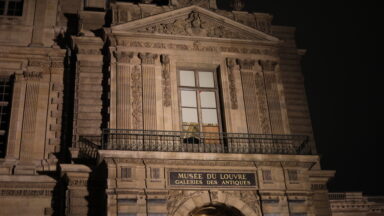
On a bright morning in October 2025, four men reportedly infiltrated the Louvre Museum in Paris, the world's most frequented museum, and made off with crown jewels valued at €88 million ($101 million) in under eight minutes. This audacious theft occurred in one of the most surveilled cultural institutions globally, yet visitors were oblivious, and security only reacted after the alarms were triggered. The thieves vanished into the bustling city streets before anyone realized the extent of the crime. Investigators uncovered that the robbers had cleverly disguised themselves as construction workers by donning high-visibility vests. They arrived equipped with a furniture lift, a common sight in Paris’s narrow avenues, which they used to access a balcony overlooking the Seine. By appearing as ordinary workers, they blended seamlessly into their surroundings. This tactic succeeded because human perception often operates through established categories of what we expect to see. The thieves adeptly exploited these social norms to evade suspicion. The incident highlights a significant parallel with artificial intelligence (AI) systems, which can also fall victim to similar cognitive biases. Sociologist Erving Goffman’s concept of the 'presentation of self' elucidates how individuals perform social roles based on societal expectations. In the case of the Louvre, the thieves' act of normality served as perfect camouflage. Humans consistently utilize mental categorization to interpret their environment, allowing things that fit within the 'ordinary' category to go unnoticed. AI systems that perform tasks such as facial recognition or monitoring for suspicious behavior operate on comparable principles, albeit through mathematical frameworks rather than cultural lenses. Both humans and AI rely on learned patterns, which can lead to biases. The robbers were not perceived as threats because they conformed to a familiar archetype. Conversely, AI systems may disproportionately flag individuals who do not fit the statistical norm, leading to over-scrutiny of certain racial or gender groups. This phenomenon underscores that AI does not create its categories; it adopts our societal norms. When trained on security footage where 'normal' is defined by specific appearances or actions, AI systems are likely to replicate those biases. The incident at the Louvre serves as a reminder that categorization, whether by humans or algorithms, is a double-edged sword. While it aids in swift information processing, it also embeds our cultural biases. Both people and machines engage in pattern recognition, an efficient yet flawed strategy. Adopting a sociological perspective on AI reveals that algorithms act as reflections of our social constructs. In the Louvre heist, the robbers succeeded not by becoming invisible, but by fitting into the accepted norms of behavior. Their ability to pass as 'ordinary' illuminates the intricate relationship between perception and categorization in our algorithmically driven world. Whether it’s a security guard assessing who looks suspicious or an AI algorithm identifying potential shoplifters, the fundamental process remains the same: categorizing individuals based on culturally learned cues that seem objective. When AI is labeled as 'biased,' it often mirrors these entrenched social categories too accurately. The Louvre robbery serves as a stark reminder that our perceptions shape not only our attitudes but also what we choose to notice. In response to the theft, France’s culture minister pledged to enhance security measures with new cameras. However, regardless of advancements, these systems will still depend on categorization, meaning that biases may persist if the underlying assumptions remain unchanged. The Louvre heist will be remembered as one of Europe’s most daring museum thefts, showcasing the robbers' mastery of social perception and the implications of categorical thinking. Their success in broad daylight was not merely a triumph of planning but rather an illustration of how conformity can be mistaken for safety. Before we can improve AI's ability to 'see,' we must first scrutinize our own perceptions.
Elon Musk Reflects on the Unexpected Acceleration of AI Development
Elon Musk has expressed that his initial efforts to curb the concentration of artificial intelligence power may have ina...
Business Insider | Jul 24, 2026, 04:15Divorce Drama: Tech Mogul's Ex-Wife Faces Setback in AI Wealth Battle
The surge in wealth from the booming AI industry is reshaping fortunes, yet the former spouse of one of South Korea's le...
CNN | Jul 24, 2026, 05:45
China's Memory Chip Giant CXMT Set to Challenge Market Dynamics with Major IPO
ChangXin Memory Technologies (CXMT), China's leading memory chip manufacturer, is preparing for a significant public lis...
CNBC | Jul 24, 2026, 02:15
Strategic Payroll Solutions: Preparing for Future Growth
As businesses evolve, so do their payroll needs. Consider a mid-sized company that, after implementing a payroll system ...
Business Insider | Jul 23, 2026, 21:15AI Guardrails: A Double-Edged Sword for Cybersecurity Researchers
In recent months, leading AI companies have implemented stringent regulations and vetted programs to curb potential misu...
TechCrunch | Jul 24, 2026, 01:15