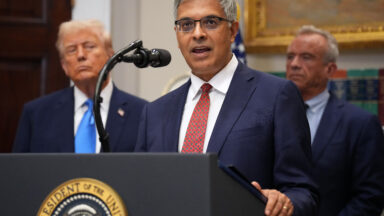
With NIH in chaos, its controversial director is taking over CDC, too
In a surprising turn of events, Jay Bhattacharya, the head of the National Institutes of Health (NIH), has stepped into the role of acting director at the Centers for Disease Control and Prevention (CDC). This unusual dual appointment has sparked immediate backlash from researchers and public health advocates, who are concerned about the implications for the agency's integrity and effectiveness. Bhattacharya's new responsibilities come during a tumultuous period at the Department of Health and Human Services, led by Health Secretary Robert F. Kennedy Jr., known for his anti-vaccine stance. This marks the third leadership change at the CDC under Kennedy's administration. Previously, Susan Monarez, a microbiologist and seasoned federal health official, briefly held the acting director position before being replaced after a month. Monarez alleges her dismissal was due to her refusal to endorse changes to vaccine guidelines proposed by Kennedy’s advisors, who have a strong anti-vaccine bias. Following Monarez, Jim O’Neill took over as acting director. O’Neill, who had a background in Silicon Valley as an investor, approved significant modifications to the CDC's childhood vaccination protocols during his tenure. However, he has since departed from the CDC and is reportedly in line for a nomination to lead the National Science Foundation, which currently lacks both a director and deputy director. While Bhattacharya, a health economist with a medical degree, brings a level of expertise that may be beneficial for the CDC, his leadership has come under scrutiny. Critics point to his administration at the NIH, which has seen the cancellation or freezing of substantial research funding, including a staggering $561 million earmarked for studying the leading causes of death in the United States, as highlighted in a recent Senate report. Furthermore, over 300 clinical trials have faced defunding under his watch, and a significant number of NIH institutes are currently without directors, marking an unprecedented leadership vacuum.
Deezer Reports AI-Generated Music Surpasses 50% of Daily Uploads
Deezer, the popular music streaming service, has been closely monitoring the influx of AI-generated tracks on its platfo...
TechCrunch | Jul 21, 2026, 14:00
AI Giants Ramp Up Lobbying Efforts as Tech Spending Shifts
OpenAI and Anthropic have significantly escalated their federal lobbying investments, marking a record high in the secon...
CNBC | Jul 21, 2026, 16:45
The Challenges of Open-Weight AI: Why China's Approach Is Struggling
The recent enthusiasm surrounding China's open-weight AI models is overshadowed by a stark reality: they are fundamental...
Business Insider | Jul 21, 2026, 17:50Snap Joins TikTok in Settling Controversial Social Media Lawsuit
In a significant move, Snap has reached a tentative settlement in a lawsuit claiming that social media platforms pose ri...
TechCrunch | Jul 21, 2026, 15:10
Google Unveils New AI Models Amid Delays for Gemini 3.5 Pro
In a recent announcement, Google introduced three new AI models that prioritize speed and cost-efficiency over sheer pow...
Business Insider | Jul 21, 2026, 15:15