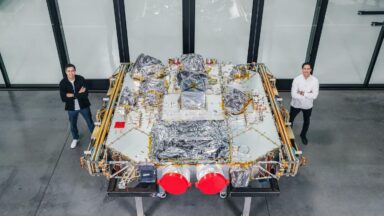
Investors commit quarter-billion dollars to startup designing “Giga” satellites
A burgeoning startup, K2, focused on producing a new generation of high-power satellites, has successfully secured $250 million in funding to enhance its production capabilities at its facility in Southern California. This significant financial boost was announced on Thursday and is part of K2's Series C funding round, which was spearheaded by Redpoint Ventures, along with contributions from various investment firms across the U.S., U.K., and Germany. Since its inception in 2022, K2 has raised over $400 million and is on track to execute its first major demonstration mission in the upcoming year. The company aims to capitalize on the anticipated increase in heavy and super-heavy launch capacities, particularly with SpaceX’s Starship expected to begin satellite deployments next year. Additionally, Blue Origin’s New Glenn rocket has made two launches this year, with more scheduled for 2026, while advancements continue on an even larger version of New Glenn. This trend towards larger rockets is echoed by the capabilities of other launch systems, including SpaceX’s Falcon 9 and Falcon Heavy, United Launch Alliance’s Vulcan, and innovative vehicles from companies such as Rocket Lab, Relativity Space, and Firefly Aerospace. K2's founders are confident that the satellite market will shift back towards larger spacecraft, moving away from the recent trend of miniaturization, to meet the demands of emerging sectors like in-space computing and data processing. The company is developing two satellite classes, dubbed Mega and Giga, which will be manufactured at their expansive 180,000-square-foot factory in Torrance, California. The first satellite in the Mega Class, named Gravitas, is set to launch in March 2026 aboard a Falcon 9 rocket. Once deployed, Gravitas will test critical systems that are integral to K2’s strategy for growth. Among its features is a groundbreaking 20-kilowatt Hall-effect thruster, which K2 claims will surpass the power output of any similar thruster previously flown. Gravitas will also utilize twin solar arrays designed to generate 20 kilowatts of energy. K2’s co-founder and CEO, Karan Kunjur, highlighted the significance of Gravitas, stating, "Gravitas brings our full stack together for the first time. We are validating the architecture in space, from high-voltage power and large solar arrays to our guidance and control algorithms, and a 20 kW Hall thruster, and we will scale based on measured performance."
Waymo to Launch Standalone App, Ending Exclusivity with Uber in Major Cities
For the past three years, Uber and Waymo, the autonomous vehicle division of Alphabet, have collaborated to provide driv...
CNBC | Jul 24, 2026, 21:55
SpaceX Successfully Tests Starship Rocket, Launching New Era of Space Exploration
On Friday evening, SpaceX executed a significant milestone by launching its colossal Starship rocket from its facility i...
CNBC | Jul 25, 2026, 24:10
OpenAI's Micro Keypad: A Novelty for Coders or Just a Confounding Gadget?
Last week, OpenAI made its debut in the hardware landscape with the launch of Micro, a stylish keypad designed to integr...
TechCrunch | Jul 25, 2026, 24:40
Waymo Considers Parting Ways with Uber Amid Rising Tensions
Waymo is reportedly exploring options to exit its partnership with Uber, which has allowed the Alphabet-owned firm to de...
TechCrunch | Jul 24, 2026, 21:00
Nvidia Strikes Major Deal with SK Hynix to Secure AI Memory Supply
Nvidia has successfully forged a significant partnership with South Korea's SK Hynix to secure memory supplies essential...
CNBC | Jul 25, 2026, 05:15