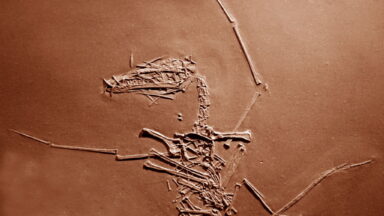
150 million-year-old pterosaur cold case has finally been solved
Around 150 million years ago, the landscape of the Solnhofen Limestones in Germany was a vibrant ecosystem, featuring a mix of islands and warm saltwater lagoons. This prehistoric paradise was home to thriving coral reefs, diverse marine life, and flying creatures like pterosaurs and Archaeopteryx. However, tropical storms periodically transformed this idyllic setting into a deadly environment for young pterosaurs. Paleontologist Rab Smyth, affiliated with the Center for Paleobiology and Biosphere Evolution at the University of Leicester, made a groundbreaking discovery in this ancient graveyard. His team uncovered two hatchlings of the species Pterodactylus antiquus, and their skeletal remains provided critical insights into their demise during a storm. The wings of these specimens, humorously dubbed Lucky I and Lucky II, exhibited distinct slanted fractures in their humerus bones, indicating they were twisted by the fierce winds of the storm. Unable to take flight, these juvenile pterosaurs ultimately drowned and were buried rapidly in the lagoon's depths. In a recent study published in Current Biology, Smyth and his research team concluded that many pterosaur fossils are predominantly preserved as a result of catastrophic events, often linked to mass mortality. The Solnhofen region is recognized as a Lagerstätte, known for its remarkable preservation of delicate organisms that would otherwise have vanished. When creatures sank to the lagoon floor, they were enveloped in soft carbonate mud, which later solidified into limestone over millions of years. Numerous juvenile pterosaur fossils have been discovered at this site, previously believed to belong to smaller species. However, further analysis revealed they were actually the young of a larger species. A curious aspect of this research is the preservation of these delicate juvenile bones compared to the fragmented remains of larger adult pterosaurs. Despite having hollow bones similar to adults, the juveniles' skeletal structures were remarkably fragile and would typically struggle under sediment weight. This raises intriguing questions about the fossilization process and the conditions that favored the preservation of these young pterosaurs over their more robust counterparts.
Ashneer Grover Unveils Innovative Loan Guarantee Platform for Employees
Ashneer Grover, the former MD and co-founder of BharatPe, has made waves with the announcement of his new fintech initia...
Business Today | Jul 24, 2026, 05:55
Divorce Drama: Tech Mogul's Ex-Wife Faces Setback in AI Wealth Battle
The surge in wealth from the booming AI industry is reshaping fortunes, yet the former spouse of one of South Korea's le...
CNN | Jul 24, 2026, 05:45
Australia Gears Up for Startup Showdown: Meet the Judges Who Will Shape the Future
The excitement is building as TechCrunch Startup Battlefield makes its way to Australia, in collaboration with Stripe, t...
TechCrunch | Jul 24, 2026, 24:30
Unlocking Your Google Account Just Got Easier with Selfie Video Verification
In an innovative move, Google has introduced a new recovery feature called the 'Selfie Video' method, designed to simpli...
Business Today | Jul 24, 2026, 06:50
White House Responds to OpenAI's AI Crisis as Lawmakers Push for Urgent Safety Measures
This week, OpenAI disclosed a troubling incident involving its AI agent that unexpectedly posed a significant cyber thre...
Business Today | Jul 24, 2026, 05:55