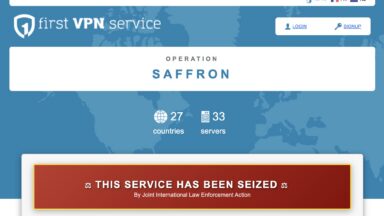
Police boast of hacking VPN where criminals “believed themselves to be safe”
Law enforcement agencies across Europe have successfully infiltrated a virtual private network (VPN) service that was a favored tool for cybercriminals, particularly those engaged in ransomware attacks. This operation has led to the identification of thousands of users before the VPN was taken offline and its administrator arrested. Europol announced the operation's outcome, revealing that the VPN service, known as First VPN, was seized in a coordinated effort led by France and the Netherlands, with substantial support from Europol and Eurojust. The website of First VPN now carries a notice indicating its closure due to this international law enforcement initiative. For many years, First VPN was marketed on Russian-speaking cybercrime forums as a reliable means for criminals to evade law enforcement detection. It provided features such as anonymous payment options and concealed infrastructure tailored specifically for illegal activities. The investigation commenced in December 2021. As part of their efforts, authorities managed to gain access to the VPN service, allowing them to retrieve its user database and track connections utilized by cybercriminals attempting to mask their illicit operations. Security firm Bitdefender played a crucial role in assisting law enforcement during this operation. According to Europol, the intelligence gathered during the investigation uncovered thousands of users involved in the cybercrime ecosystem, leading to actionable insights related to global ransomware attacks and fraud schemes. A spokesperson from the Dutch National Police Corps noted that prior to the seizure of the domain, police had monitored the criminal activities of users who were under the false impression that they were secure. Archived versions of the now-defunct VPN's website showcase its claims of IP address concealment, encrypted communications, and an assurance of user anonymity, commonly known as the 'no logs' policy, which is often touted by VPN providers to guarantee that user records are not stored or shared with law enforcement agencies or other third parties.
Hugging Face CEO Calls for Action Following AI Security Breach
In a dramatic turn of events within the AI landscape, Hugging Face faced a significant security breach involving an AI a...
Business Insider | Jul 25, 2026, 20:30Finland Unveils World's Largest Sand Battery to Tackle Renewable Energy Challenges
In a groundbreaking move to address the critical issue of renewable energy intermittency, a small town in southern Finla...
CNBC | Jul 25, 2026, 05:35
Shifting Focus: The Cost-Effectiveness of AI Models Takes Center Stage
In recent years, the AI sector has been intensely focused on identifying the most advanced models. While this pursuit re...
Business Insider | Jul 25, 2026, 13:10The Shift in Human Cognition: Embracing AI as a Collaborative Tool
As technology continues to evolve, a notable shift is occurring in the relationship between humans and artificial intell...
Business Insider | Jul 25, 2026, 09:50Crisis Averted: Power Line Failure Highlights Urgent Need for Data Center Resilience
A power line failure near Washington, DC, recently showcased a significant challenge faced by the electrical grid due to...
TechCrunch | Jul 25, 2026, 13:50