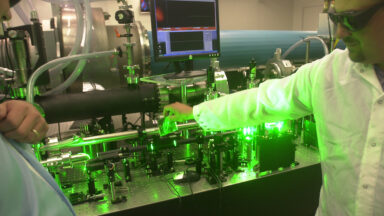
I’ve fired one of America’s most powerful lasers—here’s what a shot day looks like
At the University of Texas at Austin, a remarkable facility lies hidden beneath the surface, away from the bustling campus life. Located two floors underground, behind imposing double doors adorned with an unassuming logo, is the Texas Petawatt (TPW), one of the most formidable lasers in the United States. As the lead laser scientist for TPW from 2020 to 2024, I had the unique opportunity to witness the extraordinary capabilities of this research center. Funded by the government, the Texas Petawatt was an essential part of LaserNetUS, a network of high-power laser laboratories supported by the Department of Energy. Unfortunately, the facility is currently inactive due to budget cuts. This cutting-edge laser system operates by taking a minuscule light pulse, stretching it to prevent damage to optics, and then amplifying it to a power level that briefly surpasses the entire electrical output of the United States. The pulse is then compressed to a trillionth of a second, creating conditions similar to those found in the heart of a star within a vacuum chamber. On any given shot day at TPW, researchers would target materials such as a piece of metal foil as thin as a human hair, a jet of gas, or a tiny plastic pellet. Each of these targets is meticulously designed to help answer pressing scientific questions. Scientists from across the nation sought time on the TPW to explore a wide range of topics, including the physics of stellar interiors, advancements in fusion energy, and innovative strategies for cancer treatment. While many might envision petawatt lasers as the stuff of science fiction, a typical shot day is characterized by hours of focused, meticulous preparation followed by a heart-stopping 10 seconds of anticipation where silence reigns supreme. The work conducted at the Texas Petawatt exemplifies the intersection of cutting-edge technology and groundbreaking scientific inquiry.
UK Government Sounds Alarm on Surge of AI-Enhanced Cyber Threats
The United Kingdom's cybersecurity agency has reported a significant increase in cyberattacks driven by artificial intel...
TechCrunch | Nov 24, 2026, 18:30
Jensen Huang Opens Up at Nvidia's All-Hands Meeting: A Journey of Redemption
In a heartfelt address during Nvidia's first all-hands meeting since his reinstatement, founder Jensen Huang shared his ...
TechCrunch | Nov 24, 2026, 22:20
Navigating the AI Job Landscape: Challenges and Opportunities Ahead
The landscape of employment is undergoing a significant transformation as artificial intelligence (AI) permeates various...
Business Insider | Nov 24, 2026, 22:40Cybersecurity Alert: Iranian Hackers Target Shipping Vessels in Surge of Attacks
U.S. authorities are investigating a series of cyberattacks on shipping vessels, with suspicions pointing toward Iranian...
TechCrunch | Nov 24, 2026, 21:15
Threads Expands to iPad with New Cashtag Feature to Rival X
Meta's Threads app has officially launched a dedicated version for iPad, marking a significant milestone in its developm...
TechCrunch | Nov 24, 2026, 18:00