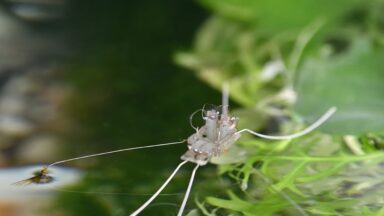
Robotic bug literally walks on water
In a remarkable leap for robotics, researchers have developed a tiny robot inspired by the Rhagovelia, commonly known as the water strider. These semi-aquatic insects are renowned for their ability to effortlessly glide across the surface of water, a feat that has now been replicated in robotic form. The inspiration behind this innovation comes from the unique fan-like appendages of the Rhagovelia, which adapt based on the water's movement. Unlike other water strider species, these insects possess specialized structures at the ends of their middle legs that adjust according to the surface tension and elasticity of the water below. This allows them to perform rapid maneuvers with astonishing agility, almost as if they are flying. Victor Ortega-Jimenez, a biologist at the University of California, Berkeley, dedicated five years to uncover how these insects navigate their aquatic environment. Contrary to previous beliefs that their leg fans were muscle-powered, Ortega-Jimenez discovered that these appendages automatically respond to the water's dynamics, opening and closing at speeds exceeding ten times that of a blink. The fans expand upon contact with water and alter their shape in response to the flow, generating significant propulsion. In addition to their impressive maneuverability, the Rhagovelia's leg fans serve a dual purpose. They are rigid enough to maintain their form when extended while being flexible enough to retract without hindrance when the insect is on land. Additionally, the legs of these insects are hydrophobic, preventing water accumulation that could impede their movement. To design a robot based on the water strider's mechanics, Ortega-Jimenez and his team utilized scanning electron microscopy to analyze the structure of the leg fans. Through their experiments, they revealed that the fans consist of numerous flat barbs with barbules, a finding that had not been previously recognized. This discovery opens up new possibilities for the development of semi-aquatic robots, potentially enhancing their efficiency and capabilities in various environments.
Ashneer Grover Unveils Innovative Loan Guarantee Platform for Employees
Ashneer Grover, the former MD and co-founder of BharatPe, has made waves with the announcement of his new fintech initia...
Business Today | Jul 24, 2026, 05:55
Flipkart Enters the Food Delivery Arena, Challenging Major Competitors
Walmart's e-commerce powerhouse, Flipkart, is gearing up to launch its own food delivery platform, igniting competition ...
Business Today | Jul 24, 2026, 07:15
China's Memory Chip Giant CXMT Set to Challenge Market Dynamics with Major IPO
ChangXin Memory Technologies (CXMT), China's leading memory chip manufacturer, is preparing for a significant public lis...
CNBC | Jul 24, 2026, 02:15
AI Guardrails: A Double-Edged Sword for Cybersecurity Researchers
In recent months, leading AI companies have implemented stringent regulations and vetted programs to curb potential misu...
TechCrunch | Jul 24, 2026, 01:15
Divorce Drama: Tech Mogul's Ex-Wife Faces Setback in AI Wealth Battle
The surge in wealth from the booming AI industry is reshaping fortunes, yet the former spouse of one of South Korea's le...
CNN | Jul 24, 2026, 05:45