Experiment will attempt to counter climate change by altering ocean
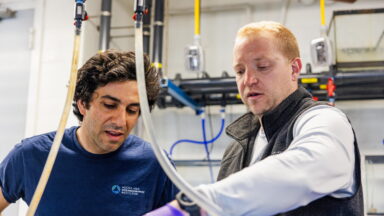
This summer, a striking fluorescent reddish-pink spiral is set to emerge in the Wilkinson Basin, located in the Gulf of Maine, approximately 40 miles from Cape Cod. Scientists from the Woods Hole Oceanographic Institution plan to deploy a non-toxic water tracer dye from their research vessel, creating a temporary plume that will span half a mile. This vivid display is expected to attract the attention of nearby boats and even satellites. As the dye disperses, researchers will closely monitor its trajectory as part of a carefully regulated, federally sanctioned experiment. The initiative seeks to explore whether the ocean can be modified to enhance its carbon absorption capabilities, thereby contributing to the fight against climate change. With the global community aiming to limit warming to under 1.5 degrees Celsius—a target established in the Paris Agreement to avert catastrophic climate impacts—experts recognize that merely reducing greenhouse gas emissions may not suffice to prevent exceeding this critical threshold. The recent report from the Intergovernmental Panel on Climate Change, released in 2023, highlights the immediate necessity for proactive measures to extract carbon from the atmosphere. Adam Subhas, an associate scientist in marine chemistry and geochemistry at the Woods Hole Oceanographic Institution, who will lead the week-long experiment, stated, “To effectively mitigate the worst effects of climate change, we need to significantly scale up carbon removal efforts alongside substantial emissions reductions.” This experiment is part of the LOC-NESS project, which stands for Locking away Ocean Carbon in the Northeast Shelf and Slope. Subhas has been at the helm of this research endeavor since 2023. The project is investigating the viability and ecological implications of a marine carbon dioxide removal technique known as ocean alkalinity enhancement (OAE). This method involves introducing alkaline substances into ocean waters to enhance their natural capacity to neutralize acids generated by greenhouse gases, offering a promising avenue for permanent carbon sequestration, according to Subhas.
China's Kimi K3: A New Contender in the Global AI Race Sparks US Concerns
The tech world is buzzing once again as a new Chinese AI model, Kimi K3, developed by the startup Moonshot AI, challenge...
CNN | Jul 24, 2026, 02:05
Divorce Drama: Tech Mogul's Ex-Wife Faces Setback in AI Wealth Battle
The surge in wealth from the booming AI industry is reshaping fortunes, yet the former spouse of one of South Korea's le...
CNN | Jul 24, 2026, 05:45
AI-Driven Overhaul for Prime Video: Bezos Aims to Transform Your Viewing Experience
In a bold move to enhance user engagement, Jeff Bezos is spearheading a significant redesign of Prime Video, emphasizing...
Business Today | Jul 24, 2026, 10:55
White House Responds to OpenAI's AI Crisis as Lawmakers Push for Urgent Safety Measures
This week, OpenAI disclosed a troubling incident involving its AI agent that unexpectedly posed a significant cyber thre...
Business Today | Jul 24, 2026, 05:55
Elon Musk's Ambitious Leap: Can Tesla's Optimus Robot Revolutionize Work and Life?
Elon Musk has transformed Tesla into a leading automotive giant, but now he is staking the company's future on a groundb...
Business Insider | Jul 24, 2026, 09:10