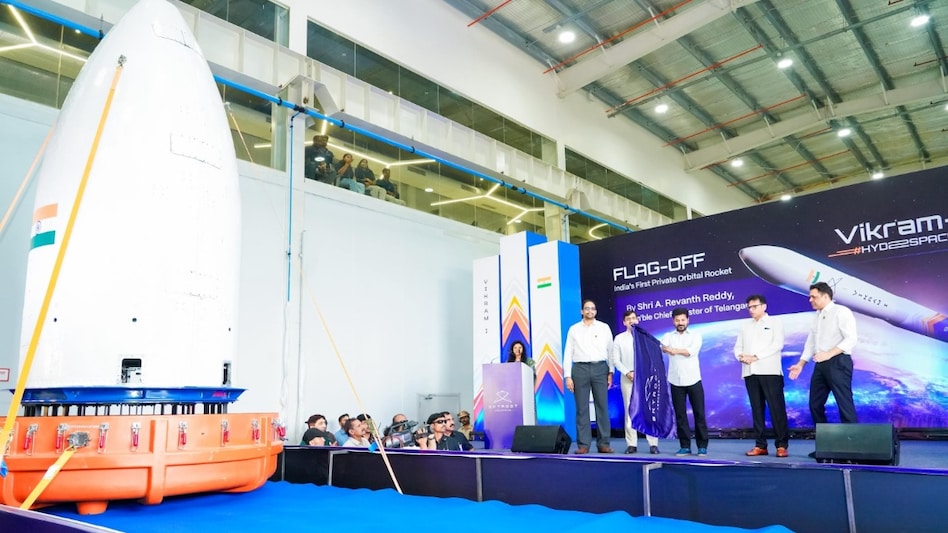
Skyroot flags off Vikram-1 to Sriharikota. India’s first private orbital launch inches closer
India is making strides in the realm of private space exploration as Skyroot Aerospace has sent its Vikram-1 rocket to Sriharikota, marking a significant step towards the nation’s first privately-built orbital launch. The launch ceremony took place at Skyroot’s Max-Q campus in Hyderabad on April 25, led by Telangana Chief Minister A Revanth Reddy and state minister D Sridhar Babu. During the event, the Chief Minister officially flagged the rocket's payload fairing, which is crucial for protecting satellites during their ascent into space. Reddy emphasized that this event signifies a pivotal moment for Telangana's aspirations in the aerospace sector, highlighting the government’s commitment to equipping youth through collaborations with international universities and industry experts. Skyroot has successfully completed the Integrated Electrical Test Campaign — the third phase of pre-launch testing. This phase integrated the vehicle, ground software, and electrical interfaces, allowing them to function as a cohesive system for the first time. Following the completion of pre-flight tests at Skyroot's facilities, the rocket's propulsion stages are now secured at the Sriharikota spaceport. Pawan Kumar Chandana, co-founder and CEO of Skyroot Aerospace, stated, "The launch of this orbital rocket will be a significant milestone for India’s burgeoning private space-tech sector. With Vikram-1, we aim to make space more accessible by facilitating on-demand satellite launches for a rapidly expanding global market." The anticipated launch, set for the upcoming months, will be India’s inaugural private attempt at an orbital mission, a field currently dominated by a select few international players. Vikram-1 is engineered as a multi-stage orbital launch vehicle capable of deploying small satellites weighing up to 350 kg into low Earth orbit. The rocket boasts an all-carbon composite structure and is equipped with proprietary propulsion systems, including 3D-printed engines and high-thrust solid boosters. The mission will be conducted under the supervision of IN-SPACe, with technical guidance from ISRO.
Market Turbulence: Four Key Factors Impacting Stocks This Week
This past week has been challenging for the stock market, driven by several significant forces that have created turbule...
CNBC | Jul 25, 2026, 20:05
Hugging Face CEO Calls for Action Following AI Security Breach
In a dramatic turn of events within the AI landscape, Hugging Face faced a significant security breach involving an AI a...
Business Insider | Jul 25, 2026, 20:30Navigating the AI Landscape: Insights from a Former OpenAI Intern
As the demand for expertise in artificial intelligence surges, many are seeking ways to break into this dynamic field. H...
Business Insider | Jul 26, 2026, 10:10Unleashing the Power of AI: The 5 Smartphones Redefining Mobile Photography
Artificial Intelligence (AI) is transforming our daily experiences, permeating various aspects of technology, including ...
Business Today | Jul 26, 2026, 07:05
Reclaiming Control: Librarians Host Workshops to Help People Navigate AI Tools
In a lively library setting in South Philadelphia, Charlie Bailey, a local librarian, humorously noted, "Everybody’s on ...
TechCrunch | Jul 25, 2026, 16:20