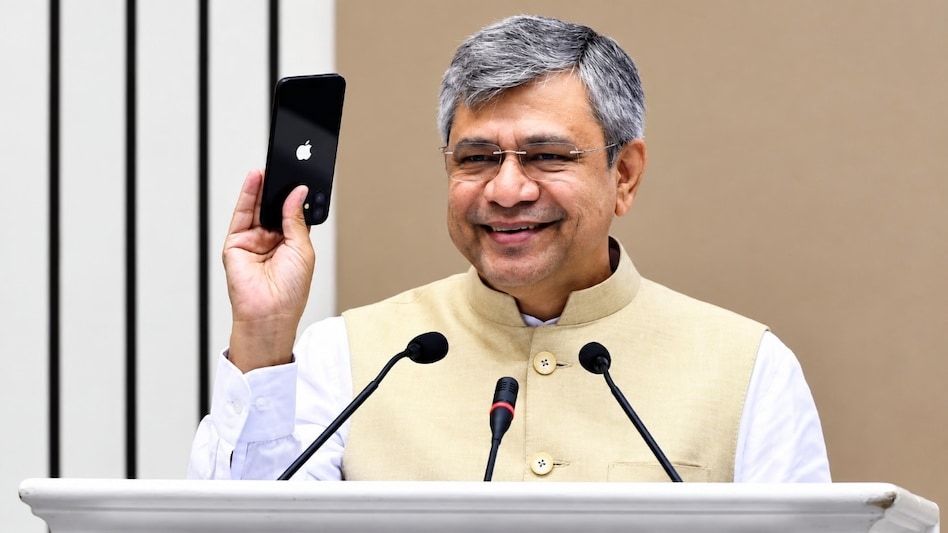
Does India subsidise Apple’s iPhones? Ashwini Vaishnaw responds with numbers
The expansion of Apple’s iPhone manufacturing in India has sparked debate regarding the use of taxpayer-funded subsidies. Critics question whether these incentives are genuinely fostering a robust domestic electronics ecosystem or merely facilitating product assembly. In response to the growing concerns, Ashwini Vaishnaw, India's Union Minister for Electronics and IT, provided insights supported by data on tax revenues and employment generated through the Production Linked Incentive (PLI) scheme. In a recent discussion, he highlighted that the government has garnered ₹25,000 crore in direct tax collections and ₹3 lakh crore in GST revenue, while the expenditure under the mobile manufacturing incentive program stands at ₹19,000 crore. Vaishnaw emphasized the positive impact on employment, stating that the electronics manufacturing sector currently employs 2.5 million people, with 1.2 million specifically in mobile manufacturing. He framed the PLI scheme as a success story, attributing job creation and tax revenue generation to its implementation. To counter critics, he quipped, “Cope harder.” However, concerns raised by Bloomberg’s Andy Mukherjee add a nuanced layer to the discussion. Mukherjee recently dismantled an iPhone in Hong Kong to analyze its components and scrutinize India’s manufacturing capabilities. He acknowledged the rapid growth of India's manufacturing sector, estimating that it has positively influenced the mobile trade balance by $2.1 billion within a year. Despite the progress, Mukherjee pointed out significant challenges, such as India’s reliance on importing high-value components like memory chips, processors, and camera lenses. He expressed skepticism regarding whether the value added through local manufacturing sufficiently compensates for these imports, especially as the cost of imported components is typically higher than that of exported finished mobile phones. Furthermore, he raised questions about the efficacy of the financial incentives designed to stimulate local manufacturing, suggesting that the cost to taxpayers could outweigh the benefits in terms of wages for factory workers. He also noted that rising global prices for memory chips could further inflate manufacturing costs. While the debate continues, there remains no definitive evidence suggesting that the PLI scheme has resulted in a net loss for India, leaving room for further analysis and discussion on the future of mobile manufacturing in the country.
Investing in the Future: Solar and Battery Solutions for AI Data Centers
The challenge of powering AI data centers has emerged as a pivotal issue in the current technological landscape. Over th...
TechCrunch | Nov 24, 2026, 16:25
realme P4x 5G vs vivo Y31t 5G: Which Smartphone Offers the Best Bang for Your Buck?
When it comes to choosing between the realme P4x 5G and the vivo Y31t 5G, potential buyers are faced with distinct advan...
Business Today | Nov 24, 2026, 01:50
Nvidia's Leadership Shakeup: CFO Excluded from CEO Reinstatement Talks
Nvidia's chief financial officer, Colette Kress, who had a brief stint as interim CEO, was reportedly not included in se...
Business Today | Nov 24, 2026, 15:15
Revolutionizing Cybersecurity: AI's Role in Modern Threat Detection and Defense
As businesses increasingly embrace digital transformation and artificial intelligence, the complexity of cybersecurity t...
Business Today | Nov 24, 2026, 08:30
Figma Engineer Files Lawsuit Claiming Workplace Harassment and Retaliation
A former engineer at Figma has initiated legal action against the design software firm and its CEO, Dylan Field, citing ...
TechCrunch | Nov 23, 2026, 23:15