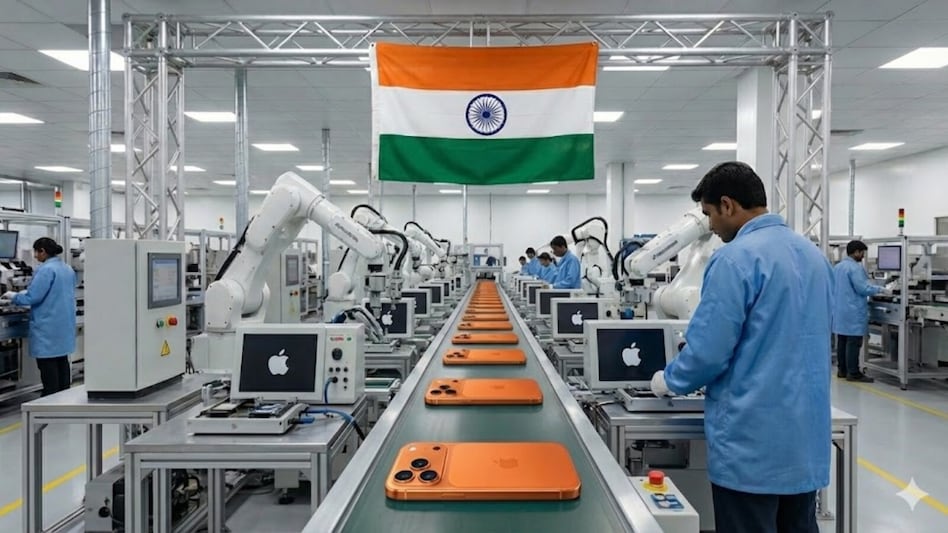
India assembles 1 in 4 iPhones, but how much of the product’s real value does it capture?
India's role in the assembly of Apple's iPhones is on the rise, significantly impacting global electronics supply chains. However, this increase in assembly does not necessarily equate to a proportional increase in economic value captured by the country. In 2025, it is estimated that India assembled around 55 million iPhones, marking a 53% increase from the previous year and representing roughly 25% of Apple's global production. This expansion is part of Apple's strategy to diversify its manufacturing operations away from China due to various challenges, including tariffs, geopolitical issues, and supply chain vulnerabilities. Despite the impressive assembly figures, a closer look reveals a substantial gap between the assembly process and the higher-value activities that contribute to the overall worth of the iPhone. For instance, in a hypothetical breakdown of a $1,000 iPhone, Apple captures $450 from design, software, and brand value, while suppliers from Taiwan, South Korea, Japan, and the US contribute significant portions as well. Both India and China, however, account for only $30 each through assembly, pointing to a limited share of the product's total economic value. The involvement of manufacturers like Foxconn, Tata Electronics, and Pegatron has bolstered Apple's production capabilities in India, allowing the country to assemble various iPhone models, including premium versions. Recent incentives, such as US tariffs on Chinese imports and India's production-linked incentive (PLI) scheme, have catalyzed this shift in manufacturing. Nevertheless, simply increasing assembly volumes does not guarantee that a larger fraction of economic value stays within India. The domestic economic impact is contingent upon factors such as local wages, supplier revenues, component sourcing, taxation, and the degree of Indian firms' engagement in higher-value manufacturing activities. To truly enhance domestic value addition, India must focus on expanding local sourcing beyond assembly. Apple has started to localize the production of components like batteries and enclosures, and its manufacturing ecosystem is gradually expanding to include other products like AirPods. However, developing a robust supplier network will necessitate significant investments in technology, skills, infrastructure, and advanced manufacturing capabilities. The challenges posed by imports are evident, with India's electronics trade revealing a stark contrast: imports reached $116 billion in the last financial year, while exports were only $48 billion. While Apple's manufacturing push can enhance employment, exports, and industrial capacity, the reliance on imported components continues to restrict the economic value retained in India. To advance its electronics strategy, India must not only attract assembly lines but also build a comprehensive component manufacturing sector, fortify local suppliers, and transition into more technology-intensive segments of the value chain.
realme P4x 5G vs vivo Y31t 5G: Which Smartphone Offers the Best Bang for Your Buck?
When it comes to choosing between the realme P4x 5G and the vivo Y31t 5G, potential buyers are faced with distinct advan...
Business Today | Nov 24, 2026, 01:50
Figma Engineer Files Lawsuit Claiming Workplace Harassment and Retaliation
A former engineer at Figma has initiated legal action against the design software firm and its CEO, Dylan Field, citing ...
TechCrunch | Nov 23, 2026, 23:15
Electric Truck Innovator Harbinger Secures Major Funding from Erebor Bank
Harbinger, an emerging player in the electric truck industry, has secured a significant financial boost from Erebor Bank...
TechCrunch | Nov 24, 2026, 18:00
Nvidia's CEO Jensen Huang Returns Amid Scandal and Government Intervention
In a surprising turn of events, Nvidia's board has reinstated Jensen Huang as CEO and president just two weeks after his...
TechCrunch | Nov 24, 2026, 13:45
Navigating the AI Landscape: Why CEOs Must Embrace Technology Literacy
In the rapidly evolving world of corporate India, companies are increasingly investing in artificial intelligence (AI), ...
Business Today | Nov 24, 2026, 07:35