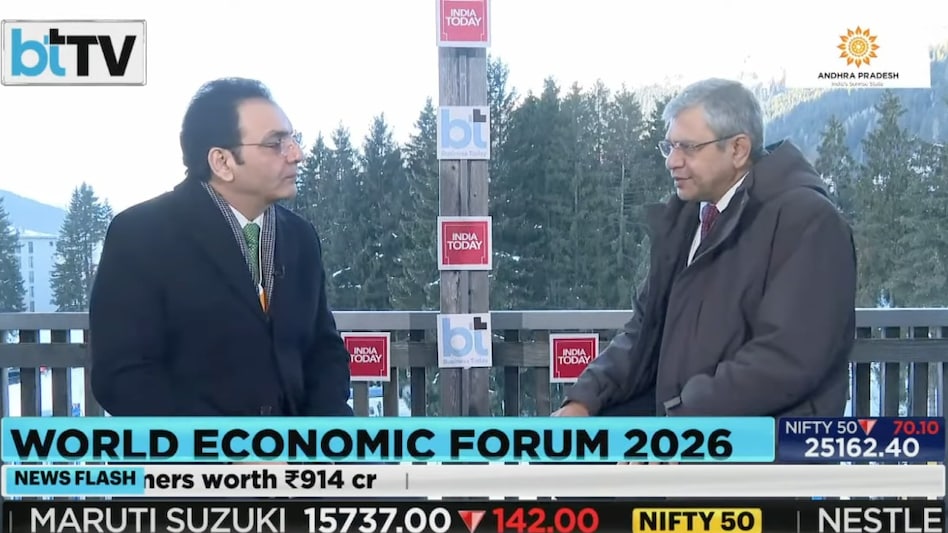
Davos 2026: India to run most AI work on sovereign models within a year, says Ashwini Vaishnaw
India is set to significantly enhance its artificial intelligence capabilities by transitioning to domestic models within a year, as outlined by Ashwini Vaishnaw, the Minister for Electronics and Information Technology. In an exclusive conversation during the World Economic Forum in Davos, Vaishnaw emphasized that India is now taking proactive steps to influence global technology trends through robust infrastructure investments and a digital-first economic framework. Vaishnaw stated, "In one year from now, most of our AI-related work should be achievable using our sovereign models." This initiative is part of India’s national AI mission, which aims to build substantial domestic computing power, models, and applications. The government's approach focuses on democratizing access to advanced technology, with plans to establish a shared national infrastructure. The minister revealed that a comprehensive suite of AI applications will soon be available for public use, supported by an expansive computing facility that currently boasts 38,000 GPUs, which will see significant expansion. He highlighted India’s unique position as the “use case capital of the world,” arguing that while large language models (LLMs) may become standardized, true value lies in their practical applications across sectors like governance, healthcare, education, agriculture, and manufacturing. In addition to AI, Vaishnaw pointed to advancements in India's semiconductor and electronics manufacturing sectors, which are pivotal to the country’s industrial strategy. He noted that India is now designing cutting-edge 2nm chips, with 24 startups involved in this innovative space. According to Vaishnaw, the nation has established a foothold in every aspect of the semiconductor value chain, from design and packaging to fabrication and electronics manufacturing. He proudly mentioned that electronics exports have now become the third-largest category of exports from India. To attract global chip manufacturers and electronics firms, the government has introduced production-linked incentive programs, capital subsidies, and long-term policy support, which help position India as a viable alternative manufacturing hub amid shifting geopolitical landscapes and supply chain diversification. Vaishnaw concluded by stating that India is increasingly viewed as a reliable global partner, capable of leveraging its scale, talent, and stable policies to foster a new model of technology-driven development.
Crisis Averted: Power Line Failure Highlights Urgent Need for Data Center Resilience
A power line failure near Washington, DC, recently showcased a significant challenge faced by the electrical grid due to...
TechCrunch | Jul 25, 2026, 13:50
Revolutionizing Office Automation: Prentis Aims to Secure $100 Million in Funding
Prentis, a newly established AI research lab, is making waves in the tech industry as it prepares to raise $100 million ...
TechCrunch | Jul 25, 2026, 24:00
The Rise of AI Distillation: A Controversial Technique Sparks Debate in Tech and Government
In recent discussions, a once-obscure topic in artificial intelligence has surged to the forefront of debates among tech...
CNBC | Jul 25, 2026, 12:15
The Aluminum Foil Trend: A DIY Shield Against Wireless Identity Theft
Have you noticed an unusual trend where people are wrapping their wallets in aluminum foil? This peculiar practice has e...
Business Today | Jul 25, 2026, 02:45
OpenAI's Micro Keypad: A Novelty for Coders or Just a Confounding Gadget?
Last week, OpenAI made its debut in the hardware landscape with the launch of Micro, a stylish keypad designed to integr...
TechCrunch | Jul 25, 2026, 24:40