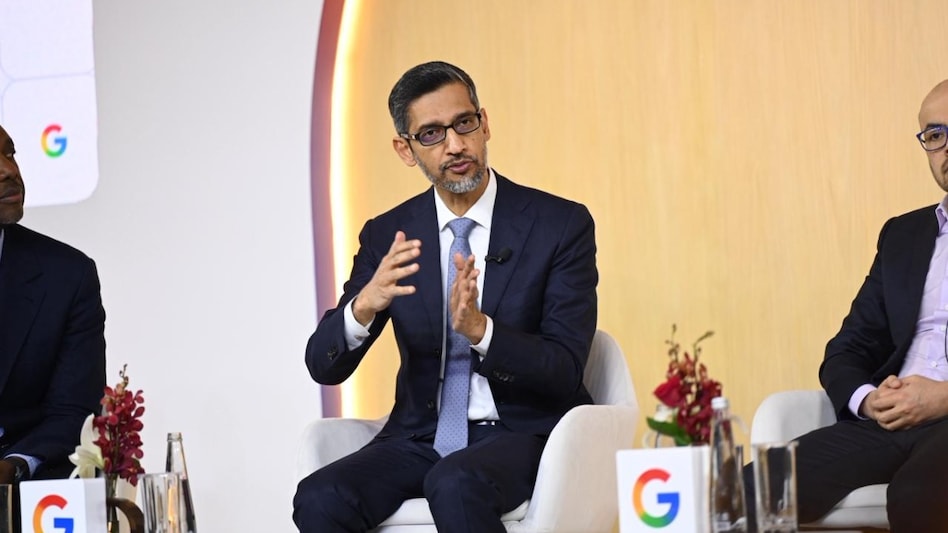
Google’s Sundar Pichai says India poised for 'extraordinary trajectory' in AI as it unveils new initiatives
Sundar Pichai, CEO of Alphabet and Google, has expressed strong optimism regarding India's future in artificial intelligence (AI), suggesting that the country is set to embark on an "extraordinary trajectory" in this transformative technology. During a Google event on February 18, Pichai highlighted new initiatives aimed at enhancing infrastructure, skills development, and research in the AI sector. Pichai emphasized that AI represents a significant technological evolution with far-reaching global effects. He stated, "AI is the biggest platform shift of our lifetime and one of the most powerful tools to solve problems and improve lives on a planetary scale." This technology holds the potential for emerging economies to overcome traditional developmental challenges, with Pichai noting, "For countries like India, AI presents a chance to leapfrog age-old gaps and create new opportunities." Google's commitment to AI is longstanding, with over a decade of investment and integration of the technology into its core products such as Search and the Gemini assistant. Pichai pointed out the establishment of a $15 billion AI hub in Visakhapatnam, along with new subsea cables under the "India-America Connect" initiative, which are designed to enhance connectivity across the region. In addition, Google is set to launch a new AI Professional Certificate program in collaboration with various governmental and educational institutions in India, aiming to empower individuals with AI expertise. Pichai also announced a strategic partnership with Karmayogi Bharat to create a framework for civil servants, asserting that Google will provide secure infrastructure to support over 20 million public servants across 800 districts and in 18 languages. Furthermore, a $30 million initiative named the "AI for Science Impact Challenge" was introduced to assist researchers leveraging AI for scientific advancements. Pichai remarked that if India continues to invest in foundational capabilities, it could emerge as a "full-stack player" in AI, encompassing research, infrastructure, and application. He underscored the importance of ensuring that AI's benefits reach the general populace, stating, "The government has a role in diffusing AI across the country so the benefits reach everyone—farmers, students, doctors." Demis Hassabis, CEO of Google DeepMind, added that AI could significantly enhance sectors where India already excels, such as agriculture and medicine. James Manyika, Alphabet’s senior vice president of research, highlighted the necessity for governments to concentrate on skill development as automation transforms the workforce. He noted, "AI affects tasks more than entire jobs," indicating a critical need for workers to acquire new skills as their roles evolve. Pichai dismissed concerns regarding the high costs of AI infrastructure, framing it as a crucial investment in a rapid global technological shift, akin to previous infrastructure revolutions but occurring at an accelerated pace.
Market Turbulence: Four Key Factors Impacting Stocks This Week
This past week has been challenging for the stock market, driven by several significant forces that have created turbule...
CNBC | Jul 25, 2026, 20:05
Reclaiming Control: Librarians Host Workshops to Help People Navigate AI Tools
In a lively library setting in South Philadelphia, Charlie Bailey, a local librarian, humorously noted, "Everybody’s on ...
TechCrunch | Jul 25, 2026, 16:20
Finland Unveils World's Largest Sand Battery to Tackle Renewable Energy Challenges
In a groundbreaking move to address the critical issue of renewable energy intermittency, a small town in southern Finla...
CNBC | Jul 25, 2026, 05:35
Nvidia Strikes Major Deal with SK Hynix to Secure AI Memory Supply
Nvidia has successfully forged a significant partnership with South Korea's SK Hynix to secure memory supplies essential...
CNBC | Jul 25, 2026, 05:15
The Shift in Human Cognition: Embracing AI as a Collaborative Tool
As technology continues to evolve, a notable shift is occurring in the relationship between humans and artificial intell...
Business Insider | Jul 25, 2026, 09:50