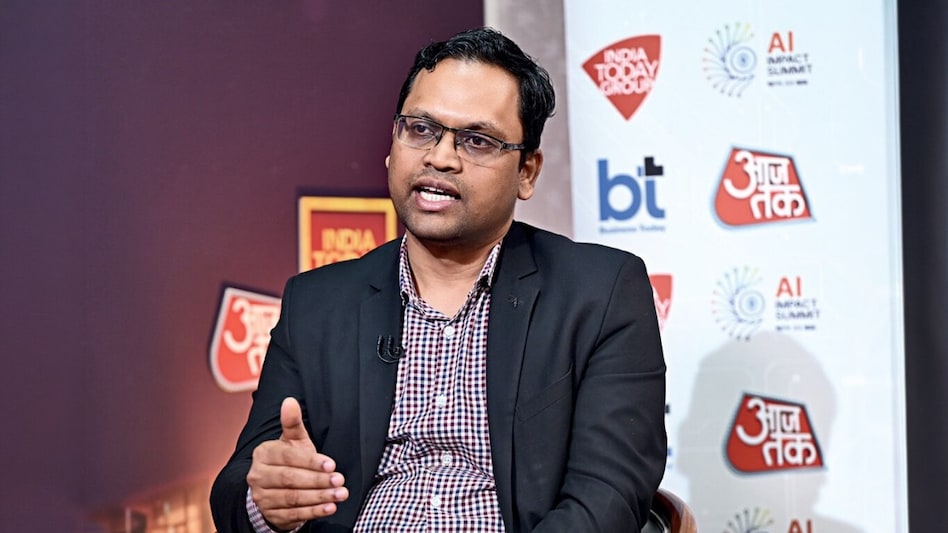
Why Sarvam CEO believes India is set to hijack the global AI race on a budget
Pratyush Kumar, co-founder and CEO of Sarvam, a prominent Indian startup, believes that while India has yet to produce the most advanced artificial intelligence models, the nation is poised to create AI solutions at a scale that leverages its unique cost advantages. Kumar expressed confidence in India's potential, stating, "I am very comfortable believing that India will not only do it at scale but also at a cost structure that works for a billion people. That is the opportunity India offers to the global effort in AI." He pointed to the finance and fintech sectors as pivotal areas driving innovation, where banks are increasingly implementing AI technologies for various applications, from customer support chatbots to fraud detection and loan underwriting. During his address at the Global Fintech Fest, Kumar drew interesting comparisons between the evolution of AI and India's rapid advancement in digital payments. He pointed out that in 2016, India was not a leading player in the digital payments space; however, it now dominates over 60% of global transactions. "I expect AI to follow a similar trajectory," he remarked. Kumar noted that we are currently in the early stages of India developing its own AI capabilities, despite the global excitement surrounding tools like ChatGPT. "We had the AI Impact Summit in Delhi this year, and we now have our own models and GPUs coming into the country. We are also upskilling our talent pool, and I believe that in the next decade, India will lead in both the adoption and development of AI," he commented. He emphasized the need for India to produce intelligence at scale, akin to its manufacturing of cars and steel, through what he called "token factories." Sarvam has managed to deploy models at competitive prices, and Kumar stressed the importance of building infrastructure that supports model serving and custom training. In the last year alone, Sarvam has achieved significant milestones, including 325 million minutes of voice AI usage, handling nearly 400 million API calls daily, and digitizing millions of documents. Kumar shared that they are collaborating with major organizations, including public sector entities like NPCI and SEBI, as well as private banks. Despite these advancements, Kumar acknowledged that the adoption of AI technologies is still in a state of flux, often occurring in isolated pockets. He noted, "There is some apprehension and risk involved in making decisions about deployment, whether for voice applications or document management." He urged the industry to embrace a holistic approach to AI deployment, ensuring that technology can be implemented quickly, securely, and effectively within regulated sectors. This is especially crucial for reaching tier 3, 4, and 5 regions where financial inclusion is vital.
Tidal Takes Bold Step Against AI Music Flood, Set to Remove Millions of Tracks
In a decisive move to combat the overwhelming influx of AI-generated music, Tidal announced on Tuesday its plans to ban ...
TechCrunch | Nov 24, 2026, 17:10
Pinterest Empowers Parents with New Controls Over AI Content for Teens
This week, Pinterest unveiled an enhancement to its parental controls, introducing a feature that allows parents to regu...
TechCrunch | Nov 24, 2026, 16:25
Investing in the Future: Solar and Battery Solutions for AI Data Centers
The challenge of powering AI data centers has emerged as a pivotal issue in the current technological landscape. Over th...
TechCrunch | Nov 24, 2026, 16:25
Emerging AI Chip Design Revolution: A Challenge to Nvidia's Reign
Nvidia, under the leadership of Jensen Huang, faces a significant challenge from the very AI technology it helped to pop...
Business Insider | Nov 24, 2026, 10:10Megaspeed Faces U.S. Blacklisting Amid Espionage Allegations
Megaspeed, a company formerly led by Alice Huang, is reportedly set to be added to the U.S. Commerce Department's Entity...
TechCrunch | Nov 23, 2026, 21:45