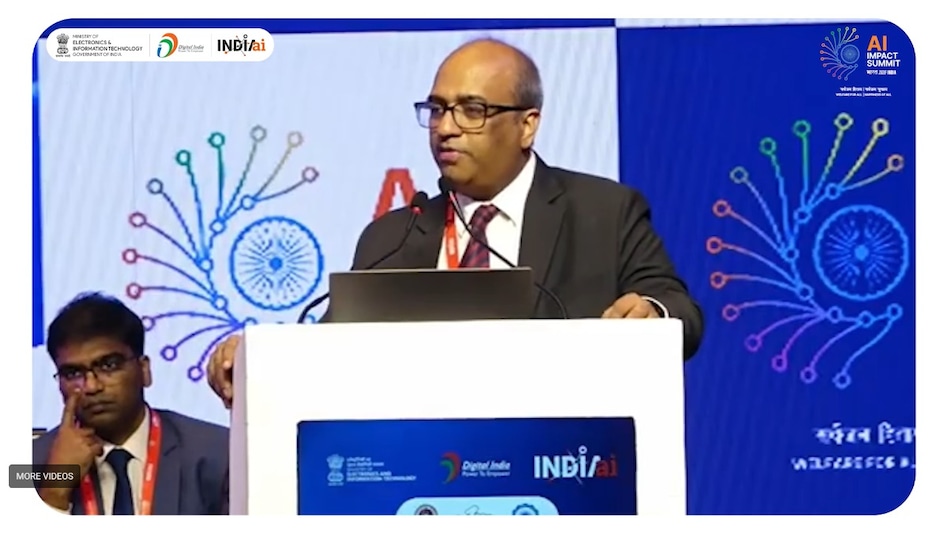
Indian IT firms must build its own coding agents to stay competitive in AI era: MeitY's Abhishek Singh
In a bold statement on February 5, Abhishek Singh, CEO of the IndiaAI Mission and Additional Secretary at the Ministry of Electronics and Information Technology (MeitY), emphasized the critical need for India to develop its own coding agents. He argued that relying solely on foreign AI tools could jeopardize the nation's competitive advantage in software services. Speaking virtually at a pre-summit conclave organized by the Confederation of Indian Industry, Singh pointed out the mounting challenges faced by India's vast IT workforce. With the rise of low-cost AI coding solutions, entry-level software engineers are finding themselves in direct competition with bots that can perform tasks for as little as $20. "When our entry-level software engineers are competing with $20 bots, how do we position ourselves?" he questioned, calling for a reevaluation of talent development and technology integration in this new AI landscape. Singh urged India's leading IT firms, including giants like TCS and Infosys, to consider whether they should continue relying on established global platforms like Cursor AI or GitHub Copilot, or take the initiative to create their own in-house coding agents. He stressed the importance of building capabilities domestically rather than transferring expertise to foreign service providers. The objective, he articulated, should be to ensure that AI tools serve as enhancements to Indian developers rather than replacements. "How do we ensure that these tools available today are seen as an add-on to the coding agents or the human software agents that we have?" Singh asked, emphasizing the need for developers to evolve alongside these technological advancements. Looking ahead, Singh shared India’s aspirations to transcend traditional IT outsourcing, venturing into innovative fields such as agentic AI and physical AI. He raised provocative questions about India's potential role as a leading provider of services for AI transformation, asserting, "Can we become the prime service providers for agentic AI? Can we become the prime service providers as we move into physical AI?" In a forward-looking statement, Singh predicted that robots could soon become a staple in households. "Within the next 3 to 5 years, just like every family thinks of having a car, they might consider having an automated assistant in the form of a robot,” he remarked, encouraging the exploration of domestic robotics manufacturing in India.
Grab the Google Pixel 10 for Just Rs 67,000 During Amazon's Final Prime Day Sale Hours!
The clock is ticking as Amazon's Prime Day Sale nears its conclusion today. Shoppers have a limited window to snag entic...
Business Today | Jul 06, 2026, 07:35
Investor Enthusiasm Fuels Surge in New Unicorn Startups
The startup ecosystem is witnessing a remarkable surge in unicorns, spurred by an investor appetite for artificial intel...
TechCrunch | Jul 05, 2026, 13:50
Heatwaves Challenge AI Data Centers: Strategies for Survival
This summer has brought unprecedented heat to regions like India and Europe, where temperatures have soared above 40 deg...
Business Today | Jul 06, 2026, 04:50
Base44's AI Model Outpaces Competitor in Website Creation Challenge
In a head-to-head comparison, Base44's newly launched AI model, Base 1, has demonstrated its potential to outperform Ant...
Business Insider | Jul 06, 2026, 05:20Investors Suffer Massive Losses in Trump's $TRUMP Memecoin Saga
Recent analysis from cryptocurrency analytics firm Nansen reveals that nearly 1 million investors have collectively lost...
TechCrunch | Jul 05, 2026, 20:50