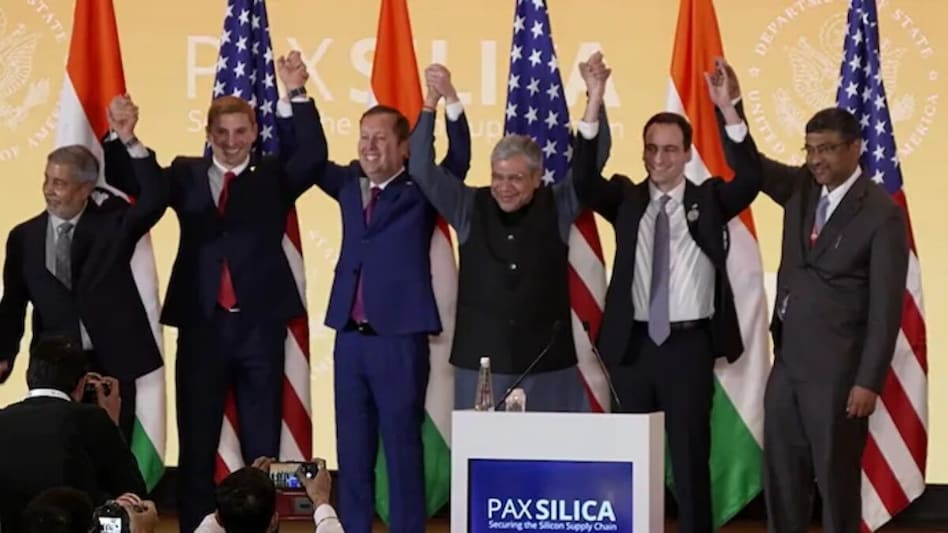
Pax Silica membership positions India at the heart of a new US-led tech order
India has officially become a member of Pax Silica, a strategic initiative led by the United States that aims to secure global supply chains for semiconductors, AI infrastructure, and critical minerals. This development underscores New Delhi's increasing influence in the geopolitics surrounding advanced technology. The Pax Silica Declaration was signed during the India AI Impact Summit, aligning India with a coalition of nations intent on reducing reliance on any single geographical source for essential components that power smartphones, vehicles, defense systems, and AI platforms. During the signing, Jacob Helberg, Under Secretary of State for Economic Affairs, emphasized the significance of the declaration, stating, "Today, we signed the Pax Silica Declaration, a document that’s not merely an agreement on paper, but a road map for a shared future… as we sign the Pax Silica, we say no to weaponised dependency, and we say no to blackmail, and together, we say that economic security is national security." Semiconductors are central to modern economies, yet their production remains concentrated in a limited number of regions. The COVID-19 pandemic and rising geopolitical tensions have revealed vulnerabilities in this model, prompting nations to prioritize resilience and self-reliance rather than the previous “global village” approach. Pax Silica represents Washington's effort to establish a trusted network across the semiconductor and AI supply chain, distributing capabilities among allied countries rather than merely replicating entire supply chains domestically. "Pax Silica signifies a new US-led geopolitical and economic order for the AI age. By forming an exclusive coalition of nations that control critical components from Dutch lithography to Japanese chemicals and Middle Eastern energy, Washington aims to create a trusted ecosystem that minimizes coercive dependencies on non-market actors, particularly China," explained Pareekh Jain, CEO at EIIRTrend & Pareekh Consulting. Analysts liken this new framework to OPEC, which historically influenced oil geopolitics, but now focuses on strategic commodities like chips, data-center infrastructure, and AI computing. India's inclusion marks a significant shift in its global role. Once seen primarily as a technology market, the country is now recognized as a vital contributor to supply-chain resilience. Initial signatories to Pax Silica included Japan, Israel, Australia, Singapore, and South Korea, with additional nations such as Greece, Qatar, the UAE, and the UK joining later. Notably, Canada, the European Union, the Netherlands, the OECD, and Taiwan are participating as non-signatory members. Technologically advanced nations like Japan, South Korea, and the Netherlands are keen to safeguard their domestic champions, coordinate on export controls to avert secondary US sanctions, and ensure continued access to US-controlled intellectual property and critical minerals. Meanwhile, energy-rich nations like the UAE and Qatar leverage their financial resources and low-cost energy to attract AI infrastructure and data centers, effectively trading investment for access to cutting-edge computing. Despite not being a major semiconductor manufacturing hub, India received a formal invitation to join Pax Silica in January 2026, a decision attributed to its policy momentum and strategic potential. "The last four years of commitment by the Indian government to foster semiconductor manufacturing, assembly, and testing in India through substantial subsidies and improved business conditions have bolstered India's candidacy as a Pax Silica member," stated Danish Faruqui, CEO at Fab Economics. Experts highlight India's strengths in talent, market size, and future manufacturing potential. "India is crucial for the US in scaling semiconductor manufacturing, especially in sectors where it relies over 70% on China, including aerospace and defense, while also securing critical mineral supply chains and offering a vast pool of high-skilled engineering talent," Faruqui noted. Jain added that India is home to a significant number of semiconductor design engineers and AI software developers, and its rapidly digitizing economy presents a substantial domestic market, mitigating the risk of rival technology ecosystems dominating the Global South. The benefits of joining Pax Silica are expected to include increased investment, integration into secure supply chains, and institutional support for India's semiconductor goals. "This framework is likely to encourage greater US and allied investment in domestic data centers and AI computing capabilities, while also providing institutional backing that lessens geopolitical risks for foreign firms establishing fabrication facilities in India," Jain said. In the short to medium term, cooperation is anticipated to center on chip design, mature manufacturing processes, supply-chain security, and advanced packaging. However, this alignment may also impose strategic limitations. "As a Pax Silica member, India would be expected to align with Western-led export controls, which could complicate its relationships with nations like China and Russia," Faruqui warned. Furthermore, joining a US-centric bloc could necessitate India taking sides in future tech-geopolitical conflicts, potentially compromising its ability to maintain a balanced foreign policy. Experts also caution that India might face pressure to adopt US-aligned standards in AI and electronics, which could restrict the flexibility needed for independent regulatory frameworks suited to its domestic context.
Crisis Averted: Power Line Failure Highlights Urgent Need for Data Center Resilience
A power line failure near Washington, DC, recently showcased a significant challenge faced by the electrical grid due to...
TechCrunch | Jul 25, 2026, 13:50
AI Revolution: Sam Altman Declares We Are in the Singularity Era
OpenAI's CEO, Sam Altman, has boldly asserted that we have reached a pivotal moment in the evolution of artificial intel...
Business Insider | Jul 26, 2026, 18:10Warner Bros. Takes Legal Action Against Amazon Over Executive Poaching Allegations
Warner Bros. Discovery has initiated legal proceedings against Amazon, accusing the tech giant of unlawful interference ...
TechCrunch | Jul 25, 2026, 21:25
The Future of Work: Executives Weigh In on AI's Impact on Gen Z Careers
As generative artificial intelligence continues to rise, uncertainty looms for the incoming Gen Z workforce. Leaders fro...
Business Insider | Jul 26, 2026, 10:15Hugging Face CEO Calls for Action Following AI Security Breach
In a dramatic turn of events within the AI landscape, Hugging Face faced a significant security breach involving an AI a...
Business Insider | Jul 25, 2026, 20:30